



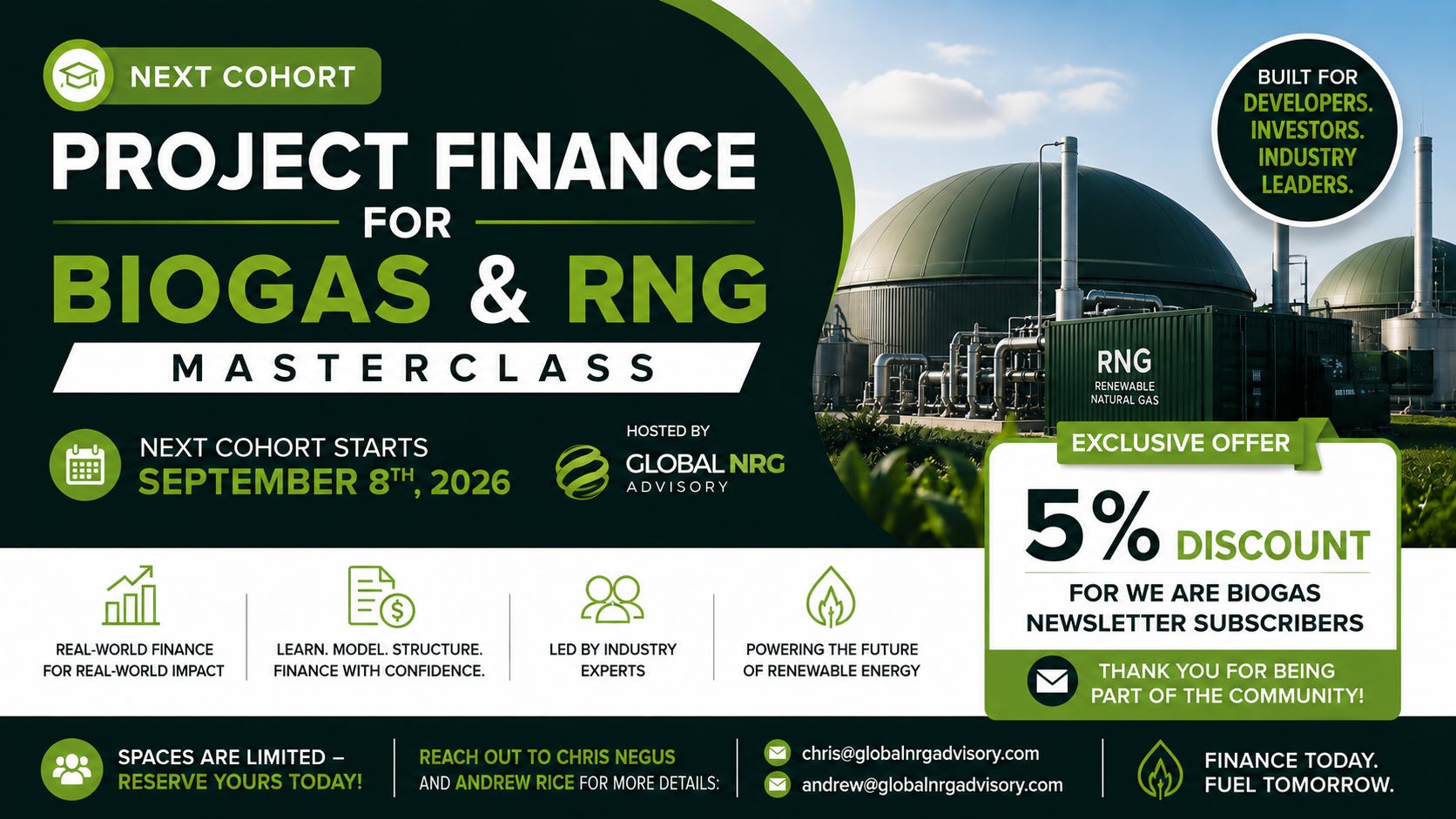
5% Discount For We Are Biogas Subscribers!
I’ve teamed up with the incredible team at Global NRG Advisory to bring you something that has been missing from this industry for far too long: a dedicated Project Finance Masterclass for biogas and biomethane professionals.
How do you actually fund a biogas project? That’s exactly what Chris Negus and Andrew Rice are breaking down across six live, expert-led modules, starting in September.
Cohorts are capped at just 15 seats. As a We Are Biogas subscriber, you have access to an exclusive 5% discount — use code WEAREBIO at checkout!
This is the kind of practical knowledge the industry actually needs. I couldn’t be more thrilled to share it with you.
👉 DM Chris Negus to get the details and secure your discounted seat! Let them know we sent you.
We Are Biogas Exclusive
The Gap Is the Story: What May 2026 Told Us About Where Biogas Is Today
By Alexandra Arndt · June 1
What is actually in the way? Not in the abstract, not as a rhetorical device, but as a precise, practical diagnosis. The distance between what biogas could be and what it currently is remains stubbornly, frustratingly wide. This month, that distance had a shape. Four distinct gaps, each showing up in different places, each requiring a different kind of attention. What’s striking — and genuinely encouraging — is that in each case, someone, somewhere, was closing one. From Kevin Gross’s front-end engineering methodology to Ben Martin’s forensic account of Ireland’s regulatory dysfunction, from India’s long-overdue grid injection guidelines to Egypt’s first wastewater-to-biogas retrofit, from the mandatory food waste collection rollout in England to the consolidation of RNG assets under institutional capital in the US and Europe, every thread builds a story about a gap being named, or a gap being closed. The floor-building, as we’ve defined previously, is the current phase of our industry, and it hasn’t stopped. It’s just become more specific about which section of the floor needs laying next.
“The sector is waiting for itself to close the implementation distance.”
Alexandra Arndt | We Are Biogas
Policy & Capital
Copenhagen Infrastructure Partners Launches a €1.7 Billion Bioenergy Fund With €200 Million From the European Investment Fund Behind It
🌍 Europe | World Bio Market Insights
Copenhagen Infrastructure Partners (CIP) has launched its Advanced Bioenergy Fund II (ABF II), targeting €1.5 billion to finance large-scale biomethane and bioenergy projects across Europe, including Denmark, Ireland, Spain, Belgium, and Finland. The fund has received a €200 million anchor commitment from the European Investment Fund, backed by EU initiatives including InvestEU and REPowerEU. CIP’s focus will be on greenfield projects in supportive regulatory markets, investing primarily in industrial-scale biogas plants using anaerobic digestion to convert agricultural waste, manure, and other organic feedstocks into biomethane. CIP’s partner heading the advanced bioenergy team described the EIF commitment as a key milestone toward the fund’s €1.5 billion target and evidence of strong market demand for domestic biomethane. With over €37 billion raised and operations across more than 30 countries, CIP’s involvement signals that biomethane has cleared a threshold.

South Carolina Signs a Landfill Gas-to-RNG Tax Credit Into Law As US State-Level Policy Momentum Builds
🇺🇸 United States | Biomass Magazine
South Carolina Governor Henry McMaster signed legislation on May 19 creating a new state income tax credit specifically supporting the development of landfill gas-to-renewable natural gas projects within the state. It is a targeted, state-level policy instrument designed to de-risk a project type that has significant potential in a state with an active landfill estate. The broader context matters: as federal policy around 45Q, 45Z, and the Inflation Reduction Act remains in flux, state-level tax credit mechanisms are becoming increasingly important load-bearing elements in US biogas project finance. South Carolina's move joins Hawaii's Clean Fuel Standard and Oregon's existing LCFS framework as evidence that US biogas support is increasingly being built through state-by-state policy architecture rather than a unified federal framework. That fragmentation is a challenge. It is also, in the current environment, the system that is functioning.
Ireland's €80 Million Cork Biomethane Plant Signs Grid Connection Agreement, Its Seventh in Three Years
🇮🇪 Ireland | The Avondhu Press
Gas Networks Ireland has signed an agreement with Stream BioEnergy to connect a new €80 million biomethane facility in Little Island, Co. Cork, to the national gas network. Currently under construction, the plant is expected to become operational in 2027, processing approximately 90,000 tonnes of domestic and commercial food and garden waste annually using anaerobic digestion to produce 80 GWh of renewable biomethane, enough to meet the annual heating demand of approximately 6,000 homes. It will be Ireland's largest biomethane plant using mixed food and garden waste, and represents Stream BioEnergy's seventh biomethane production plant contracted to connect to the national gas grid in the last three years. That last number is the one to hold onto. Seven contracts in three years is a real pipeline. The regulatory environment Ben Martin described in his exclusive with us last week, fragmented, siloed, digestate-constrained, is clearly not stopping every project. It is raising the cost and the difficulty of each one. The plants that are getting through are the ones with the right feedstock strategy, the right advisors, and enough runway to absorb the friction.
The Netherlands' EemsGas Project Secures €149.8 Million in Long-Term Operating Subsidy for Waste-Wood-to-Biomethane Production
🇳🇱 Netherlands | Renewables Now / Gasunie
The EemsGas project: a 50/50 joint venture between Perpetual Next and Gasunie, being developed at the Chemical Park in Delfzijl, has received an SDE++ operating subsidy from the Netherlands Enterprise Agency worth €149.8 million, covering the production phase from July 2029 to June 2044. Combined with a €30 million DEI+ investment subsidy already secured, EemsGas now has stacked government support across both construction and operation for what is expected to become one of the Netherlands' largest biomethane production facilities. The plant will use advanced gasification technology developed with TNO to convert waste wood into approximately 18 million cubic metres of green gas annually, with construction targeted to begin in 2027. The SDE++ mechanism is exactly what the sector consistently identifies as the missing piece in most markets: guaranteed minimum income for the operating phase, removing the revenue risk that makes long-duration project debt structuring so difficult. The Netherlands has built a mechanism that does that. The EemsGas deal is proof that it works.
Project Spotlights
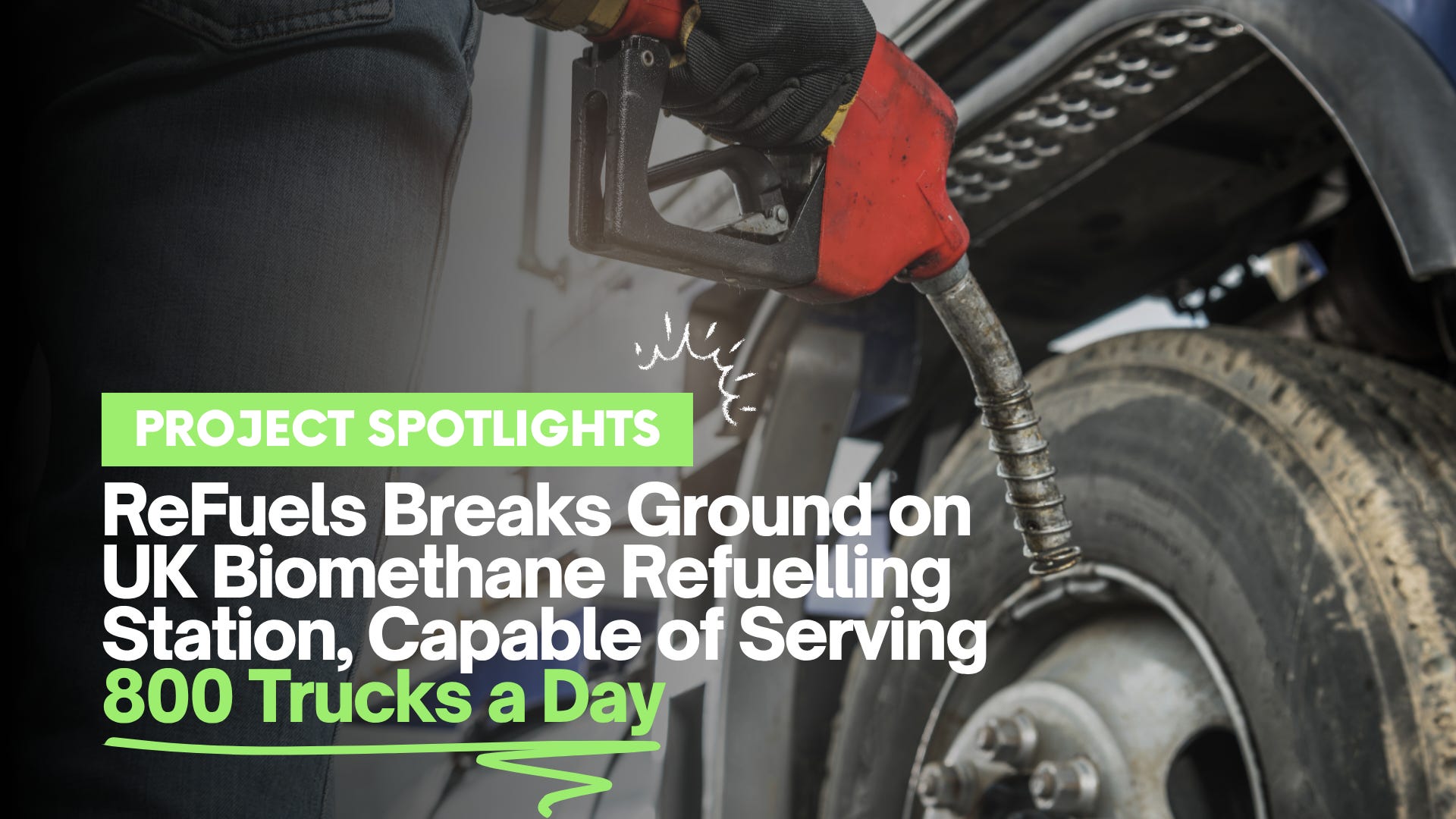
ReFuels Breaks Ground on a New UK Biomethane Refuelling Station on the M4 Corridor, Capable of Serving 800 Trucks a Day
🇬🇧 United Kingdom | FleetPoint
ReFuels N.V. has begun construction of a new public-access biomethane refuelling station in Swindon, strategically positioned with direct access to the M4 motorway to serve freight operators moving between London, Wales, and the Midlands. The station will be owned and operated by CNG Fuels, in which ReFuels holds a 40% stake, and is expected to be completed in Q1 2027. Once operational, it will be capable of refuelling up to 12 HGVs simultaneously and supporting more than 800 trucks per day, with annual dispensing capacity exceeding 30 million kilograms of 100% renewable Bio-CNG. It sits alongside a second station currently under construction in Magor, South Wales, together forming a dedicated low-carbon freight corridor along one of the UK's busiest logistics routes. ReFuels' CEO cited growing demand from fleet operators adopting the new generation of larger 6×2 gas trucks, which unlock a significantly larger addressable market. Bio-CNG produced from food waste and manure reduces greenhouse gas emissions by 85 to 90% compared with diesel, while offering fuel costs approximately 25% lower than diesel and 40% cheaper than HVO.
Oklahoma State University Signs a 10-Year RNG Partnership With Love's Alternative Energy to Power Its Campus Transit Fleet
🇺🇸 United States | Oklahoma State University
Oklahoma State University has announced a new 10-year partnership with Love's Alternative Energy, a division of Love's Travel Stops, for the operation, maintenance, and renewable fuel supply of OSU's compressed natural gas bus fuelling station. The contract, effective May 28, covers OSU's fleet of 27 transit buses serving both the Stillwater campus and the surrounding community. Love's will replace aging compressor equipment and assume full operational and maintenance responsibility. OSU has used CNG for its transit fleet since 2009, and the new agreement transitions that supply toward renewable natural gas. It's a story about institutional demand, a university, not a logistics company, locking in a 10-year RNG supply commitment for public transportation. The demand side of the RNG market is broader than it looks. Universities, municipalities, transit authorities: these are the kinds of long-duration offtake relationships that anchor project finance for upstream RNG developers.
SUEZ Breaks Ground on a New 50,000 tpa AD Plant in Northumberland as England's Mandatory Food Waste Collection Takes Effect
🇬🇧 United Kingdom | SUEZ
SUEZ has begun construction on a new anaerobic digestion plant near Ellington in Northumberland, designed to process up to 50,000 tonnes of food waste annually, producing both a recycled fertiliser product and enough green gas for around 5,500 homes. The plant is expected to be operational by the end of 2027. The announcement forms part of a broader UK commercial update from SUEZ that also includes a £396 million, 10-year contract extension with Milton Keynes City Council and a new lithium battery recycling plant. SUEZ's CEO connected all of these developments explicitly to England's mandatory food waste collection rollout, which came into force in April 2026. The timing is not incidental. Every new household food waste collection service generates a new feedstock stream that needs somewhere to go. SUEZ is building where that stream will flow. The policy creates the feedstock. The feedstock justifies the capital. The capital builds the plant.
Tech, Science & Innovation
Nature Sustainability: A Large Fraction of Current Wastewater Biogas Systems May Be Emitting More Methane Than They're Capturing
🌍 Global | Nature Sustainability
A new study published in Nature Sustainability presents a US national-scale assessment of methane leakage thresholds for wastewater biogas recovery systems, and the findings are significant. Compiling measured leakage data from over 50 facilities and the full available literature, researchers found leakage rates ranging from 0.4% to 65%, with a large fraction of current systems exceeding the net-zero emission threshold. Net-zero thresholds ranged from 2% to 10% of biogas produced, depending on heat recovery, grid emissions intensity, and the biogas utilisation pathway. The implication is uncomfortable but important: some operating biogas recovery systems may be delivering climate disbenefits rather than benefits, and the variance is wide enough to make blanket claims about wastewater biogas being net-positive unreliable without facility-specific measurement. For the sector, this is not an argument against wastewater biogas recovery; it is an argument for measurement, transparency, and operational rigour in methane management. The full climate case for biogas, as Ben Martin argued in the We Are Biogas exclusive article “Every Position Has to Perform”, depends on counting the methane correctly. That means counting what escapes as well as what gets captured.
Budweiser's Samlesbury Brewery Cuts Gas Consumption by Up to 8% With a New On-Site Biogas Recovery System
🇬🇧 United Kingdom | Gasworld
Industrial wastewater treatment firm Global Water & Energy, a subsidiary of Ekopak, has completed the installation of a biogas recovery system at Budweiser Brewing Group's Samlesbury brewery in Lancashire. As part of the on-site water treatment process, organic material from the brewing process is broken down, producing biogas as a by-product. That biogas is now reinjected into the brewery's energy system as renewable heat. The result: a 5 to 8% reduction in gas consumption and lower Scope 1 CO₂ emissions. The brewery has operated since 1972, employs around 500 people, and received a £45 million investment from AB InBev in 2021. This is another version of the retrofit story. The biogas was always being produced by the wastewater treatment process. The decision to capture it rather than flare or vent it is a capital allocation decision, and an increasingly common one as large food and beverage manufacturers face Scope 1 pressure. Brewing, distilling, food processing: the organic load in industrial wastewater is a standing biogas resource. Most of it is still going uncaptured.
Italian EV Concept Integrates a Biomethane Range Extender, A Preview of What Hybrid Fuel Architecture Could Look Like
🇮🇹 Italy | Tarantas News
Italian designer Umberto Palermo, in collaboration with Federmetano and engineering firm Reinova, has unveiled the Malya concept, a compact urban electric vehicle under four metres in length, designed to seat five passengers, and built around a biomethane range extender. The small internal combustion engine in the Malya does not drive the wheels directly; instead, it acts as a generator to recharge the battery while driving, specifically intended to reduce range anxiety and charging infrastructure dependence in urban environments. The developers point to Italy's already well-developed network of compressed and liquefied natural gas stations, noting that fully renewable biomethane is also compatible. Production is envisioned through the nanofactory model, small, flexible manufacturing sites that don't require large stamping facilities. Exact specifications and a launch timeline have not yet been disclosed. The Malya is notable not as a production vehicle but as a framing device: it positions biomethane not as a heavy transport fuel but as a range-extension solution for urban EVs, opening a demand pathway in a segment the sector rarely addresses.
Expansion & Trends
Ukraine's Poroshenko-Linked Agricultural Group Files Plans for a 200,000 tpa Biomethane Complex in Vinnytsia
🇺🇦 Ukraine | New Voice of Ukraine
UPI-Energy, a company linked to the family of former Ukrainian President Petro Poroshenko and part of the Ukrprominvest-Agro agricultural group, has launched public consultations in Vinnytsia Oblast for a planned biomethane and electricity production complex. The facility will process up to 200,000 tonnes of organic waste annually, primarily cattle manure, sugar beet pulp, and beet tops and tails from the group's own agricultural and sugar operations, producing up to 13 million cubic metres of biogas per year at a capacity of up to 1,500 Nm³ per hour. The project is being evaluated for biomethane upgrading via either membrane separation or amine scrubbing. UPI-Energy is not entering this market alone. Multiple Ukrainian producers are already shipping biomethane to Germany, and Ukraine's parliament has passed legislation enabling biomethane exports to Europe. The Ukrainian Bioenergy Association estimates the country could produce over 20 billion cubic metres of biomethane annually, potentially 20% of European market supply. A large agricultural holding with captive manure and sugar processing waste is exactly the kind of vertically integrated feedstock anchor that makes biomethane projects bankable. Watch this one develop.
McDonald's Sends Less Than 1% of Its Edible Food to Waste, And Anaerobic Digestion Is Part of How It Gets There
🍔 United States / Global | Mi Bolsillo
McDonald's has confirmed that anaerobic digestion forms part of its food waste management framework, with items that cannot be donated sent to composting stations and AD facilities for rendering and energy recovery. The company states it yields less than 1% of waste from its edible food stock through a combination of donation partnerships, including Feeding America, Food Donation Connection, and the Global FoodBanking Network, and downstream processing. It is worth noting that individual franchise practices vary significantly, and the company's approach differs meaningfully between markets, particularly between the UK and US, where policy environments for food waste diversion are different. Still, the signal is the same one that keeps appearing across this newsletter: large food service operators are increasingly treating AD not as a compliance option but as a standard component of food waste infrastructure. As mandatory diversion requirements expand, that normalisation accelerates. The demand for AD capacity is, in part, a function of how many McDonald's, Krispy Kremes, and rail operators are being held to a diversion standard.
India's REnergy Dynamics Wins Two Compressed Biogas Projects From Refex Renewables As Private Sector CBG Dealmaking Accelerates
🇮🇳 India | Bioenergy Times
REnergy Dynamics has secured two waste-to-compressed biogas projects from Refex Renewables, covering project development, engineering, commissioning, feedstock management, anaerobic digestion, gas upgrading and compression, and fuel offtake arrangements. The projects will convert municipal and organic waste into CBG for transport and industrial applications. REnergy Dynamics said it plans to use the contracts to expand its pipeline, strengthen partnerships in the renewable energy sector, and increase deployment of waste-to-CBG facilities across different supply chains. India's CBG sector has been in a sustained build-out phase following the PNGRB's grid injection guidelines and the government's SATAT scheme, which targets 5,000 CBG plants nationwide. What is notable in this story is the structure: a technology and project development company winning supply contracts from a renewables aggregator. The value chain is specialising. Feedstock managers, digestion operators, gas upgraders, and fuel distributors are beginning to function as distinct roles rather than vertically integrated functions within a single project. That specialisation is how sectors mature.
We Are Biogas is a curated weekly newsletter covering the global biogas, biomethane, RNG, and anaerobic digestion landscape.
Want to be featured? Email: alexandra@wearebiogas.com