

We Are Biogas Weekly Headline Breakdown
A curated roundup of headlines in biogas, biomethane, RNG & anaerobic digestion from around the world. 4 categories, 12 headlines, 1 exclusive interview, everything we're watching right now.

We Are Biogas Exclusive
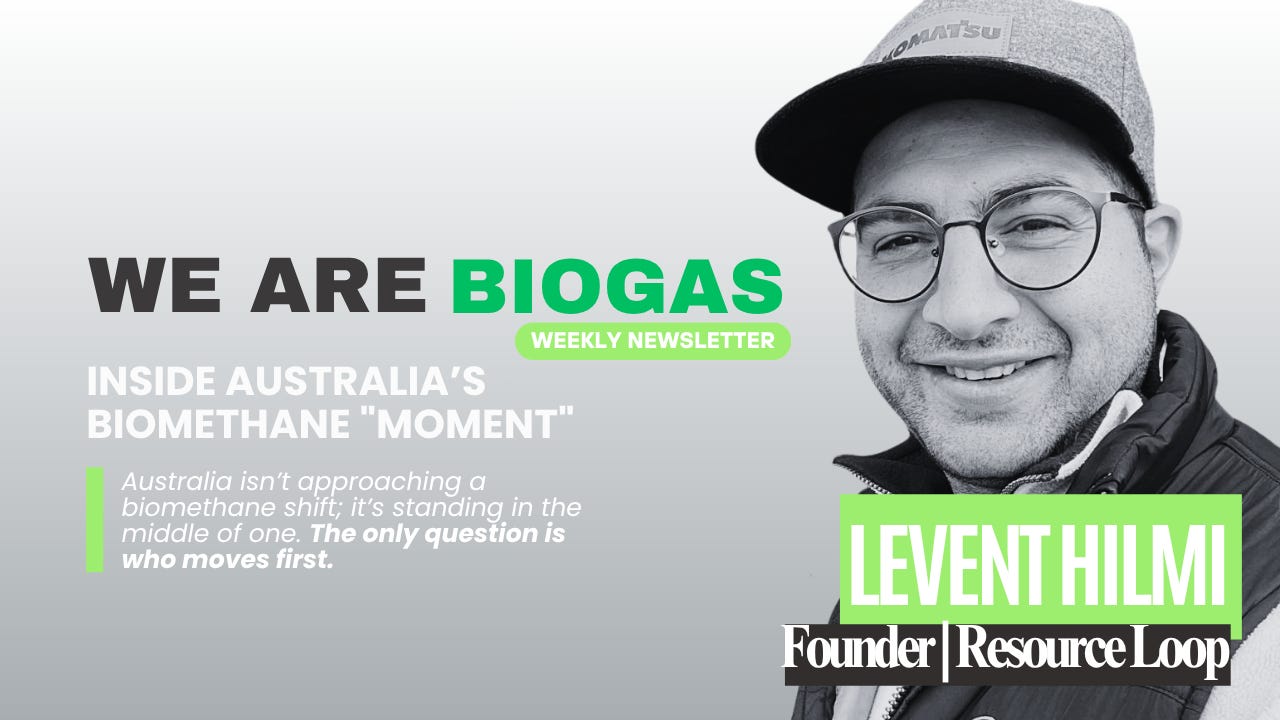
Inside Australia’s Biomethane “Moment”: A Market Finding Its Shape
By Alexandra Arndt · April 27
What’s unfolding in Australia is dynamic, fast-moving, and full of opportunity as key players figure out where the real value lies. At the center of the conversation is Levent Hilmi, Founder of Resource Loop, Head of Growth and Partnerships at Run Energy, and a veteran with 16 years of experience in landfill gas, utility-scale bioenergy, and international technology consultancy. The analysis reveals a market defined by a sophisticated jostling for value: on one side, large-scale utility operators like Jemena and AusNet, who face stranded asset risk as electrification accelerates and are pushing biomethane injection as a defensive necessity. On the other, feedstock owners, abattoirs, food processors, and agricultural hubs — weighing whether to sell gas to the grid or use it behind the meter to offset their own carbon footprints. The bankability of long-term feedstock contracts remains the critical bottleneck. Australia’s second-mover advantage is real: it can adopt proven, de-risked systems developed in Europe and North America. The “moment” is here, but it remains delicate, dependent on regulatory reform around digestate, feedstock logistics, and the persistent challenge of competing with historically low conventional gas prices.
“The feedstock is there, the technology is there, and the space is there. Yes, it might be capital-intensive at the start, but once you get a few projects over the line, the rest will follow.”
Levent Hilmi
Founder, Resource Loop | Head of Growth & Partnerships, Run Energy
Policy & Capital
Brazil Crosses 1,800 Biogas Plants as Scale and Efficiency Define the Next Phase
🇧🇷 Brazil | Petronotícias
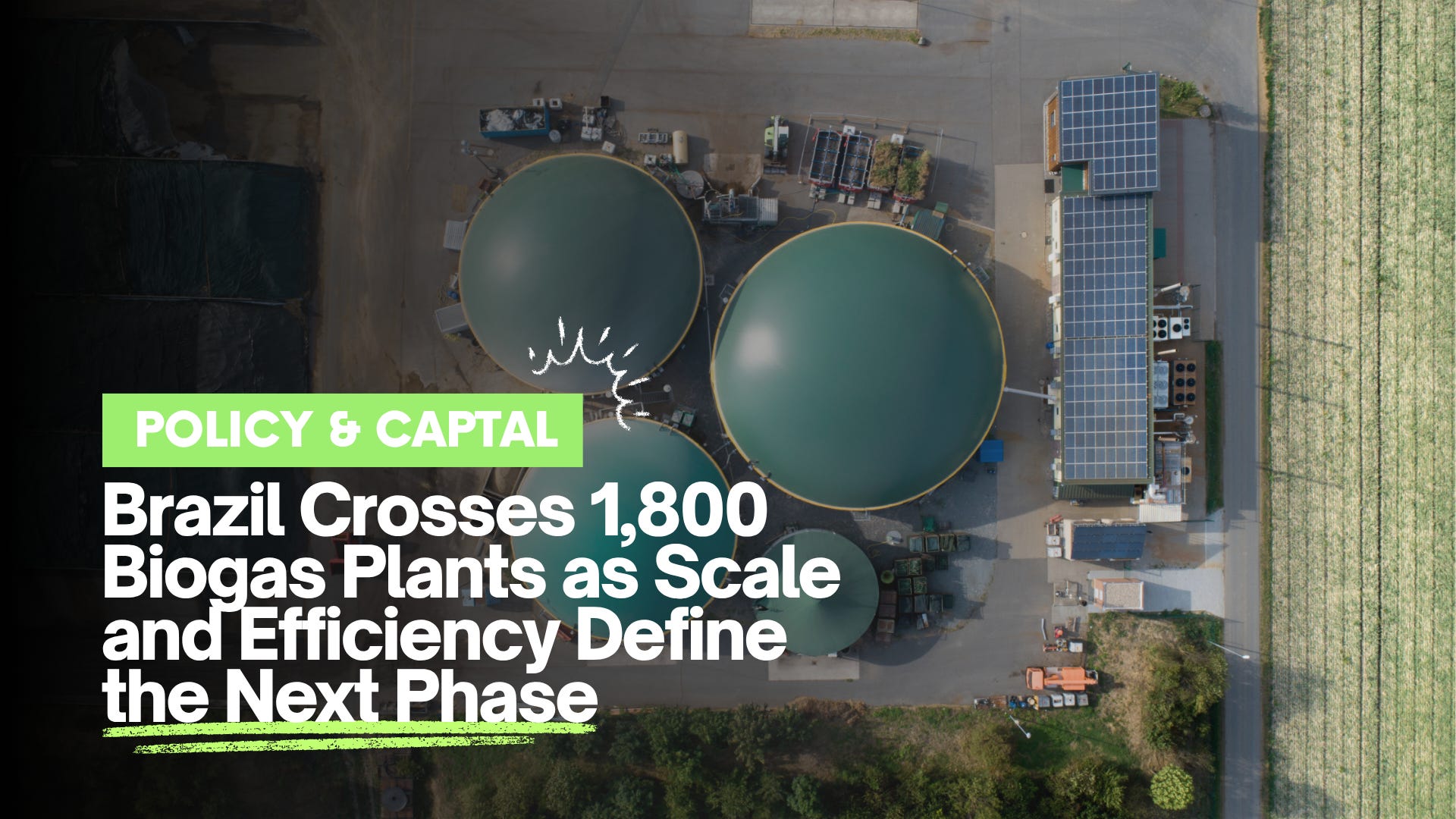
Brazil closed 2025 with 1,803 registered biogas plants and production approaching 5 billion Nm³ per year, with a 5% increase in the number of units and a 6% rise in volume produced year-over-year, according to data from CIBiogás. What the numbers reveal is a market maturing beyond simple expansion: fewer new plants are entering per year, but those coming online are larger and more productive. The distribution of production remains concentrated. São Paulo alone accounts for approximately 4.9 million Nm³ per day, but Paraná and Minas Gerais are growing above the national average, and the North and Northeast remain significantly underexploited. The more strategically important signal is the shift in end use: electricity generation still dominates at approximately 62%, but biomethane now accounts for roughly 34% of total volume despite representing a smaller share of plant count. This reflects a deliberate commercial upgrade in the sector's trajectory, with biomethane being routed toward gas markets and transport rather than simply grid power.

Ukraine Formalizes Its Biomethane Ambitions with a Government-Backed Programme Through 2035
🇺🇦 Ukraine | CEE Energy News
Ukraine's Cabinet of Ministers has approved a national Biomethane Production Development Programme running through 2035, targeting 1 billion cubic metres of output per year by 2030 and 2.1 billion cubic metres by 2035. The program provides for new plant construction, modernization of existing biogas infrastructure, investment incentives, and deregulation of grid connection procedures. Eight biomethane plants are slated for commissioning in the first implementation phase. The deeper strategic signal here is the EU alignment pathway embedded in the program: this year Ukraine plans to gain access to the EU renewable fuels database, initiate a mutual recognition agreement for guarantees of origin, and approve new natural gas quality rules. This is an accelerated bid for biomethane export status to the EU, positioned explicitly as a mechanism to reduce European dependence on Russian hydrocarbons. The infrastructure, the feedstock base, and the political motivation are all present. What this program attempts to supply is the institutional framework to match.
Ireland's €80M Cork Plant Presses Forward as the EU Blocks a Key Support Mechanism
🇮🇪 Ireland | gasworld
Stream BioEnergy has broken ground on an €80 million biomethane facility in Little Island, Cork. Backed by Goldman Sachs Asset Management and Pioneer Infrastructure Partners, even as the European Commission issued a formal detailed opinion blocking the domestic biomethane multiplier under Ireland's proposed Renewable Heat Obligation. The multiplier would have allowed one unit of Irish-produced biomethane to count as 1.5 units toward compliance, favoring domestic supply. The Commission found this incompatible with EU internal market rules. The Irish Bioenergy Association has called 2026 a "make-or-break year" for the sector. What this situation illustrates is a structural tension between national biomethane strategies and EU single market rules that Ireland is the first to hit at scale, but is unlikely to be the last. The Cork project's progress signals that well-capitalized, fully contracted projects can absorb regulatory uncertainty. Smaller or earlier-stage developers without secured offtake agreements are far more exposed. The Irish government has separately signalled a €200 million biomethane capital grant scheme later this year, which may provide an alternative pathway if the RHO framework continues to stall.
Project Spotlights
Stockholm Pipeline Inauguration More Than Doubles Liquefied Biogas Capacity in Huddinge
🇸🇪 Sweden | Renewable Energy Magazine
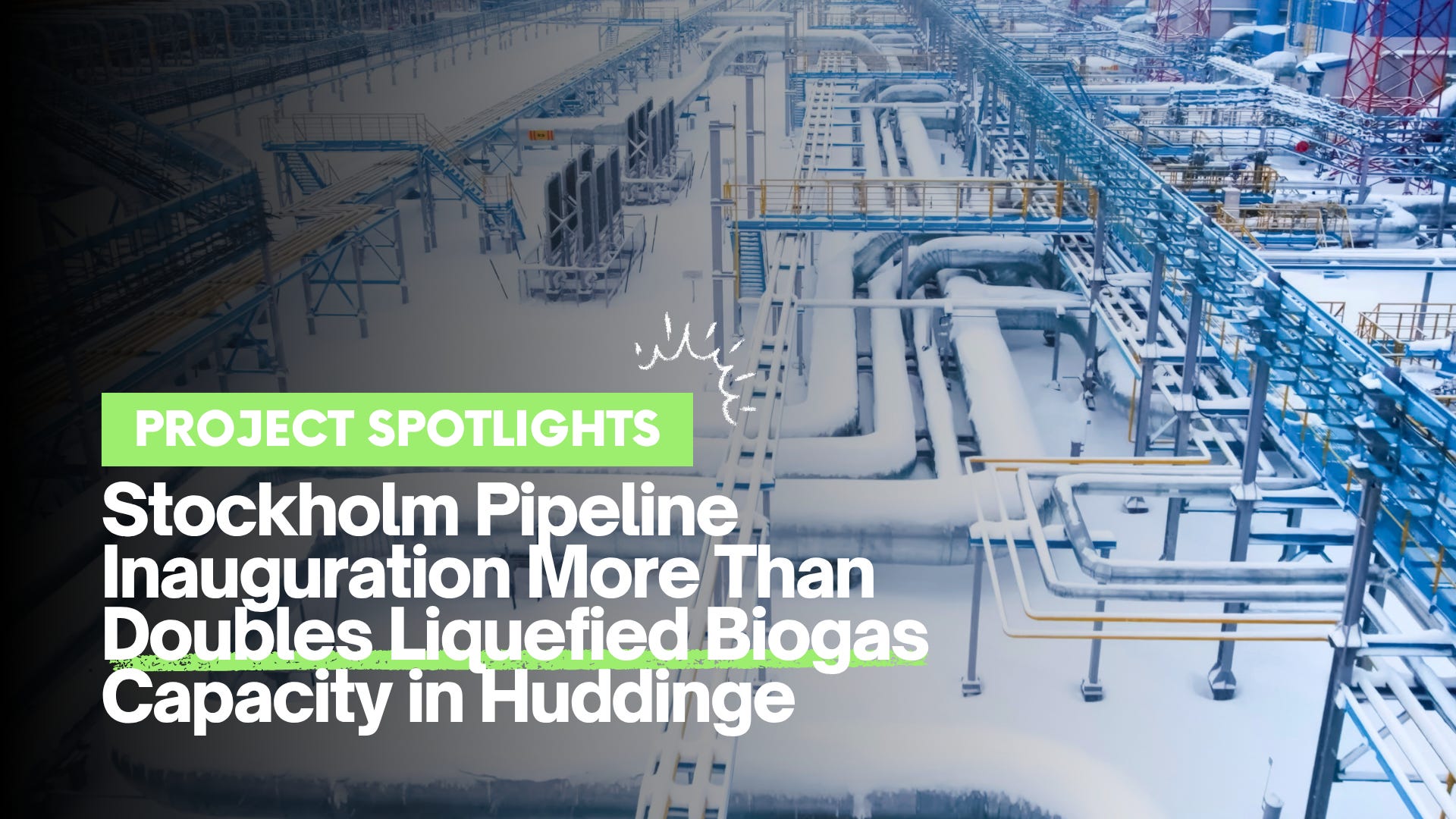
St1 Biokraft has inaugurated a new gas pipeline connecting its Henriksdal and Gladö Kvarn facilities via Stockholm's gas network. Two years in construction, supported by Sweden's Klimatklivet environmental investment program. The Gladö Kvarn LBG upgrading unit, completed in late 2023 and designed for 240 GWh output, had been operating below its potential due to the absence of a grid connection. That constraint has now been removed. The pipeline unlocks existing production at Henriksdal, which could only produce compressed biogas, by routing it to Gladö Kvarn for liquefaction, more than doubling the facility's LBG output. This is an infrastructure completion story more than a new build story. The capital was already deployed; the bottleneck was a missing grid link. It raises a question worth tracking more broadly: across the European biomethane landscape, how much existing or partially deployed capacity is constrained by analogous integration gaps rather than production limitations? Solving for the connection layer, not just the plant layer, is increasingly where the value unlock is occurring.
Anaergia and Vanguard Renewables Deepen Partnership with Fourth Minnesota RNG Deployment
🇺🇸 United States | Renewables Now
Anaergia has signed a $5.85 million contract with Vanguard Renewables for its fourth consecutive technology deployment. This time for an advanced anaerobic digestion facility in Minnesota processing food, beverage, and agricultural waste for RNG injection into the local energy distribution system. The agreement covers Anaergia's process technology, proprietary mixers, and its biogas upgrading system. The fourth deployment in a repeated partnership is analytically significant: it reflects a technology selection process that has already been validated three times. Repeated contracts between the same technology provider and developer are an indicator of operational confidence, not just commercial convenience. In an industry where technology risk remains a meaningful variable in project financing conversations, the accumulation of successful deployments in the same pairing reduces uncertainty for future capital deployment. This is how sector-level trust in specific technology stacks gets built.
Cuba's First Biomethane Plant Enters Final Assembly, Targets Bus Fuelling and Power Generation
🇨🇺 Cuba | Power Magazine
Cuba's state oil company Cupet has announced that the country's first biomethane plant, located in Martí, Matanzas province, has entered its final assembly and production phase. The facility, developed under EU funding through the UNDP and coordinated with Spain-based technical specialists from GEcrio, processes biogas from nearby pig farm biodigesters located 5–9 km away, producing approximately 40 kg of purified biomethane per hour at a compressed pressure of 200 bar. The output is designed to fuel five urban buses and two vans. With a combined range of 300–400 km per fill. While a secondary electricity generation function operates on less-purified gas. The plant represents something materially different from most of the headlines in this roundup: biomethane being deployed not as a grid-injection or export product, but as direct mobility infrastructure in an energy-constrained economy. The feedstock dependency on pig farming volumes, currently under pressure from food scarcity, is a real operational risk the article candidly acknowledges. But the model; small-scale, locally sourced, transport-integrated, is one that has relevance well beyond Cuba's particular circumstances.
“Regarding the advantages of this plant for Cuba, I’d say there are many, especially in these difficult times. On a social level, having vehicles that run on this energy could be a radical change.”
Sobeida María Reyes Martínez
Director of Development for Martí municipality
Tech, Science & Innovation
Australian Researchers Solve a Critical Scaling Barrier for Biomethane Grid Injection
🇦🇺 Australia | EurekAlert
Research led by Professor Mohsen Talei at the University of Melbourne's Faculty of Engineering and Information Technology has identified the critical specifications for safe and effective biomethane quality at scale. Directly informing the updated Australian Standard AS 4564-2025, which now formally recognises biomethane as a natural gas equivalent and introduces new contaminant limits. The specific technical problem solved relates to siloxane, a compound found in household products that, when burned in biomethane, leaves a glass-like coating on appliances, degrading performance. The team developed a predictive framework, combining simulation and experimental data, to determine how much siloxane can be present for appliances to run reliably, even at concentrations too low to study experimentally directly. This kind of research removes the barriers that stop regulatory frameworks from approving network-scale deployment. The updated standard now gives distributors, manufacturers, and regulators a shared technical foundation to work from. Australia's Malabar Biomethane Facility has already proven injection is possible; this research clarifies what responsible injection looks like at national scale.
Australian Meat Processor Begins Construction of AD Facility Targeting 35,000 Tonnes of Annual Emissions Reductions
🇦🇺 Australia | Bioenergy Insight
Casino Food Co has begun construction of the Casino Biohub, an anaerobic digestion facility at its beef processing operations in northern New South Wales. Developed in partnership with LMS Energy. The facility will include a 50 million litre covered anaerobic lagoon and a biogas flare, treating abattoir effluent that would otherwise vent directly to atmosphere. In the first stage, captured methane will be flared. A second stage is planned to convert biogas into electricity for on-site use. At full commissioning, the project is expected to reduce emissions by approximately 35,000 tonnes of carbon equivalent annually. Roughly equivalent to removing 11,200 cars from the road, and eliminate over 98% of the facility's Scope 1 emissions associated with effluent treatment. This is an important structural story for the Australian market: utility-scale grid injection project, and industrial emissions abatement deployed directly at the point of production. The combination of a University of Melbourne research breakthrough on biomethane standards (above) and this ground-level infrastructure activity illustrates the dual-track nature of Australia's biomethane development. Scientific and commercial, progressing in parallel.
Expansion & Trends
Lithuania Joins European ERGaR Hub, Opening Cross-Border Biomethane Certificate Trading
🇱🇹 Lithuania | CEE Energy News
Amber Grid, Lithuania's gas transmission operator, has joined the ERGaR Hub, the European Renewable Gas Registry platform enabling secure cross-border exchange of guarantees of origin for biomethane. With this integration, Lithuanian producers can now transfer guarantees of origin electronically to Germany, Denmark, and Slovakia. The timing coincides with significant domestic growth: at the start of 2026, Lithuania had 12 operational biomethane plants with a combined capacity of 67 MW, and in January–February alone more than 60 GWh of guarantees of origin were issued. A 2.4-fold increase over the same period in 2025. What this signals is the transition from production to marketability. Growing biomethane volumes are commercially inert without the certificate infrastructure to make them tradeable across borders. By joining ERGaR, Lithuania converts its production growth into market access, directly reaching Germany, the largest biomethane demand market in Europe. This is certificate infrastructure as commercial enablement, and its replication across smaller EU biomethane markets will be a necessary precondition for the cross-border market to function at the scale European policy targets assume.
Shanghai's Songlin Farm Demonstrates a Fully Closed-Loop Pig Waste-to-Biomethane Model
🇨🇳 China | China Daily
A large-scale pig farm on the outskirts of Shanghai is operating what China Daily describes as a 100% waste conversion system: the Songlin Ecological Agricultural Zone in Jinshan district processes approximately 100,000 metric tonnes of pig waste annually from roughly 80,000 hogs, producing 3.65 million cubic metres of biogas per year. Surplus biogas is purified into biomethane and injected into Shanghai's urban gas pipeline network, the first agricultural project to achieve this in the city. The biogas slurry fertilises 867 hectares of nearby farmland, saving an estimated 2 million yuan in fertiliser costs annually, while CO₂ produced during purification is redirected as gaseous fertiliser for on-site vegetables, reportedly increasing yields by around 20%. What makes this model analytically interesting is the degree of integration: energy, fertiliser, and food production are not separate outputs linked by policy incentives but outputs of a single engineered cycle. The closed-loop framing, where nothing leaves the system as waste, is the direction the global biogas sector is moving. China is doing it at operational scale.
Finnish Cleantech Pilot at German Biogas Site Targets Nutrient Recovery as a Structural Industry Advancement
🇫🇮 Finland / 🇩🇪 Germany | The Chemical Engineer
NPHarvest, a Finnish cleantech company specialising in nutrient recovery from waste streams, has launched a pilot plant at Biogas Westerbakum GmbH & Co KG in Saxony, Germany, processing up to 20 m³ per day of liquid digestate to recover nitrogen and phosphorus, two key fertiliser inputs. The company's membrane-based system claims up to 90% capture efficiency for both compounds in a single modular, plug-in unit designed for integration into existing large-scale biogas plants. The outputs, ammonium sulfate and calcium phosphate, are direct fertiliser inputs, not intermediates requiring further processing. This enters the newsletter at a moment when EU nitrogen regulation is tightening across member states, and Germany, as Europe's largest biogas producer, is acutely exposed to the regulatory and commercial pressure around digestate management. If that framing holds commercially, it repositions digestate from a compliance cost to a value stream, which changes the economics of existing biogas operations without requiring new infrastructure.
“We see nutrient recovery as a structural advancement for the sector, enabling operators to enhance asset productivity without expanding their physical footprint…Germany sets the benchmark for biogas operations in Europe and by integrating nutrient recovery into existing infrastructure, it has the opportunity to lead the next phase of the industry, where energy production and resource efficiency advance together.”
Juho Uzkurt Kaljunen
CEO | NPHarvest
Hydron Energy's MOF-Based Upgrading Technology Targets the Underserved Economics of Small Landfill Gas Projects
🇨🇦 Canada | Bioenergy Insight
Hydron Energy has launched a pilot Renewable Natural Gas project at the Bailey Landfill in Chilliwack, British Columbia, in collaboration with FortisBC and the City of Chilliwack, with up to C$2.3 million in funding from the NRC IRAP Clean Technology initiative. The project centres on Hydron's INTRUPTor system, a single-stage biogas upgrading platform using a novel metal organic framework (MOF) to remove both nitrogen and CO₂ simultaneously at ambient pressure. Conventional landfill gas upgrading is technically demanding precisely because of elevated nitrogen concentrations, which require higher operating pressures and multi-stage processing that typically make smaller sites economically unviable. If Hydron's single-stage approach performs as described, it changes the minimum viable scale equation for landfill biogas upgrading, opening a resource category that is globally abundant but commercially stranded. This is a technology validation project, not a commercial deployment, and the distinction matters: the claim is significant, but the proof will come from operational data. The Chilliwack pilot is the mechanism by which that proof gets generated.
We Are Biogas is a curated weekly newsletter covering the global biogas, biomethane, RNG, and anaerobic digestion landscape.
Want to be featured? Email: alexandra@wearebiogas.com