


We Are Biogas Exclusive
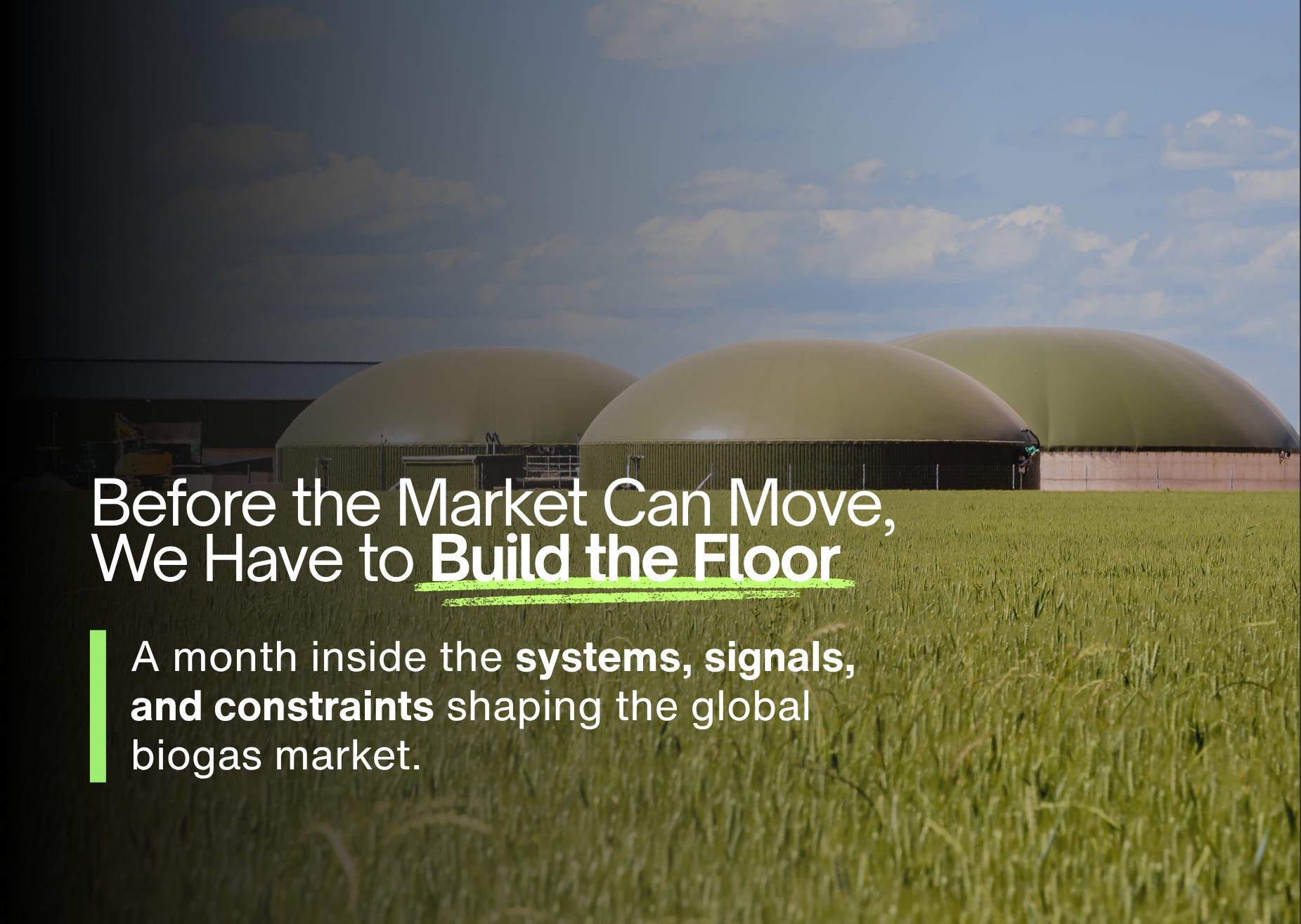
Before the Market Can Move, We Have to Build the Floor
By Alexandra Arndt · May 3
What is becoming increasingly clear in biogas is not a problem of potential, but a phase shift in progress. Across regions, policies, and operating contexts, the sector is now actively building the institutional, operational, and commercial foundations that turn isolated projects into something closer to a functioning global market. This month's analysis synthesises four conversations with practitioners at the sharp end of the industry. From a plant performance expert who has spent his career inside the gap between design ambition and operational reality, to Levent Hilmi's ground-level account of Australia's feedstock contracting gridlock, to Md. Ashrafuzzaman Ashraf's work across 4,000 household digesters in Bangladesh, to Simona Amerio's precise account of what it costs an industry in speed and resilience when the people building it aren't representative of the world they're building for. The throughline is consistent: technology is no longer the constraint. The surrounding architecture, certification systems, trading infrastructure, operational standards, carbon accounting, and leadership capacity is. Every headline this month is, in one way or another, a story about a gap being closed.
"Technology is never the limiting factor. Discipline is. Most failures weren't because the kit was wrong, but because the basics weren't being done consistently."
Flávio Ascenco
Director and Co-Founder, Agile Biogas Engineering Consultants
Policy & Capital
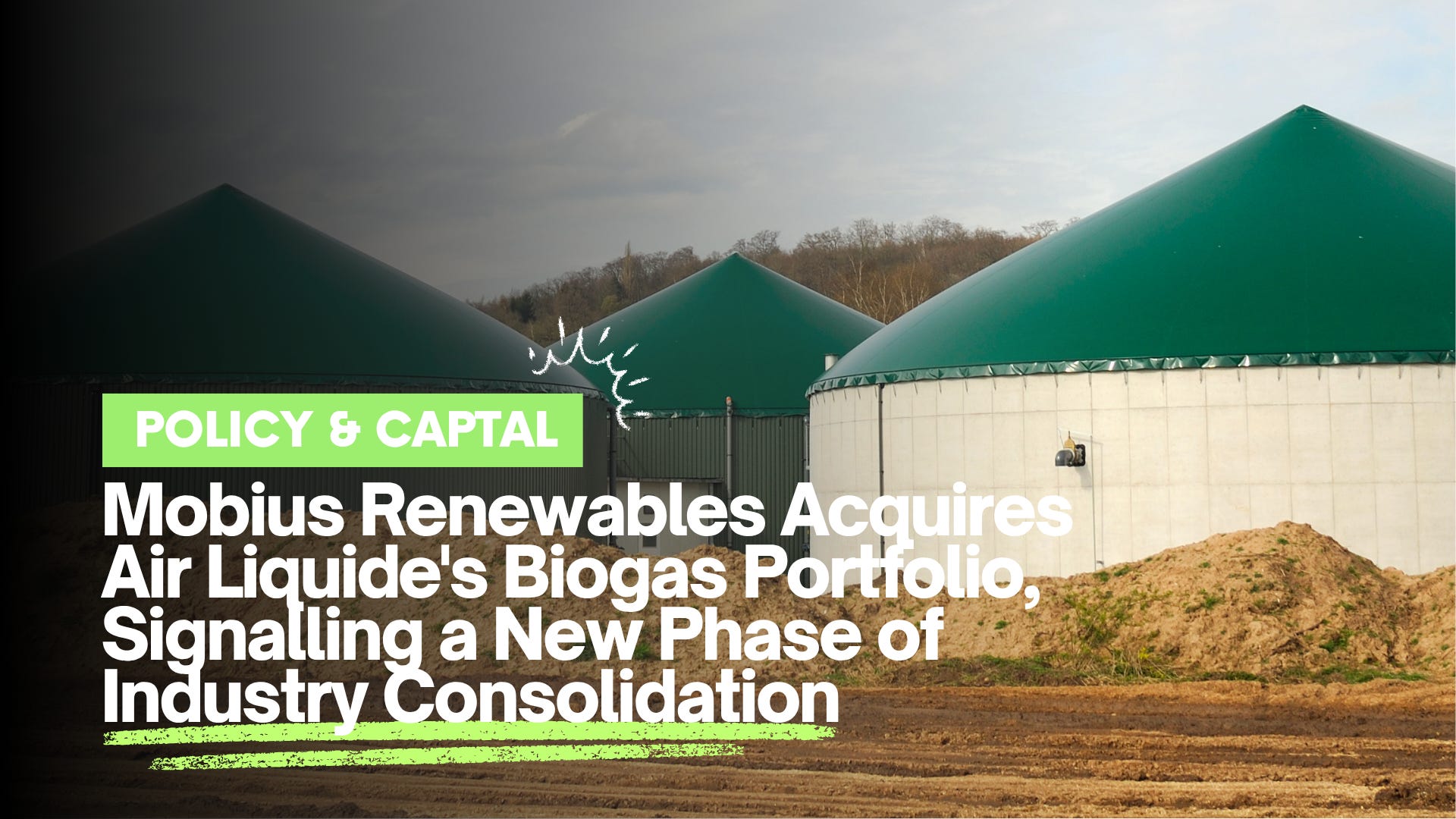
Mobius Renewables Acquires Air Liquide's Biogas Portfolio, Signalling a New Phase of Industry Consolidation
🇺🇸 🇫🇷 🇳🇴 🇸🇪 US / Europe | BioEnergy Times
Houston-based Mobius Renewables, established in December 2025 by funds managed by IFM Investors, has completed the acquisition of biogas production assets from Air Liquide across the United States and Europe. The deal includes six landfill gas-to-RNG facilities in the US, five farm waste-based plants in France, and a 51% stake in Redo Biosolutions operating across Norway and Sweden. Combined with the existing GreenGasUSA assets, Mobius now has the capacity to produce and distribute more than 5.5 million MMBtu of RNG annually. Air Liquide framed the sale as active portfolio management aligned with selective divestment strategy. What this transaction represents at the sector level is not simply an asset transfer, it is institutional capital, structured specifically for RNG, entering the market through acquisition rather than development. This is consolidation logic: fewer, larger, professionally managed operators absorbing distributed assets and applying standardised operations at scale. It is one of the clearest signals yet that RNG is no longer a development-stage asset class.

EU Turns Its Sights on France After the Ireland Ruling, Confirming a Pattern of Domestic Biomethane Support Scrutiny
🇪🇺 🇫🇷 Europe / France | gasworld
Following its detailed opinion blocking Ireland's domestic biomethane multiplier under the Renewable Heat Obligation, the European Commission has now turned its scrutiny toward France's biomethane support framework. The pattern here is important. This is not a one-off intervention against a single national program, it is the Commission applying consistent internal market principles to nationally designed biomethane support mechanisms that favour domestic production over EU imports. What Ireland and France are discovering is that the policy architecture most intuitively designed to build domestic industries, mechanisms that reward local production, is precisely the architecture the Commission is most likely to flag. Every member state designing a biomethane support system in 2026 and beyond is now operating with explicit knowledge that the Commission will enforce single market rules against domestic preference mechanisms. The sector needs support designs that are EU-market-compatible from the outset, not as an afterthought. The compliance gap between national ambition and EU rules is now the primary policy risk in European biomethane deployment.
Ireland’s RHO Design Flaw Will Push Suppliers Toward Imported Biomethane Instead of Domestic Production
🇮🇪 Ireland | Farmer’s Journal
The Irish Government has confirmed it will proceed with the Renewable Heat Obligation without the domestic biomethane multiplier after the European Commission ruled it incompatible with internal market rules. The practical consequence, as the Farmers Journal analysis makes clear, is that without the multiplier, gas suppliers obligated to incorporate renewables into their fuel mix will meet that requirement by purchasing cheaper European biomethane certificates, predominantly sourced from heavily subsidised plants elsewhere in Europe, rather than contracting Irish-produced biomethane. The result is a policy that technically fulfils its renewable heat targets while failing to build the domestic AD industry it was designed to support. Ireland’s 5.7 TWh by 2030 target now looks structurally unreachable under the current framework. A €200 million capital grant scheme has been signalled for Q3 2026, but grant aid without a functioning demand mechanism is a partial solution at best. The deeper issue is that the RHO was the demand mechanism. Without it working as designed, Ireland’s biomethane strategy has lost its commercial anchor.
India's PNGRB Closes a Critical Infrastructure Gap with Grid Injection Guidelines for Compressed Biogas
🇮🇳 India | DD News
India's Petroleum and Natural Gas Regulatory Board has approved comprehensive guidelines for the injection of Compressed Biogas into the country's Natural Gas Pipeline and City Gas Distribution networks, providing, for the first time, a standardized technical and safety framework for pipeline-based evacuation of CBG. Previously, CBG producers were largely limited to cylinder cascade transport by road, a logistically complex and cost-heavy distribution model that constrained project economics at every scale. The new guidelines cover CBG quality specifications, installation procedures, odorization requirements, safety instrumentation, and metering standards. More importantly, they establish the institutional basis for assessing project viability, giving project developers, CGD entities, technology providers, and investors a uniform framework to plan against. This is a structural unlock, not an incremental policy update. The pathway from production to end market is now defined. India's CBG sector has been capacity-constrained not by technology or feedstock, but by this exact missing layer of grid access standards. That gap has now been closed
Project Spotlights
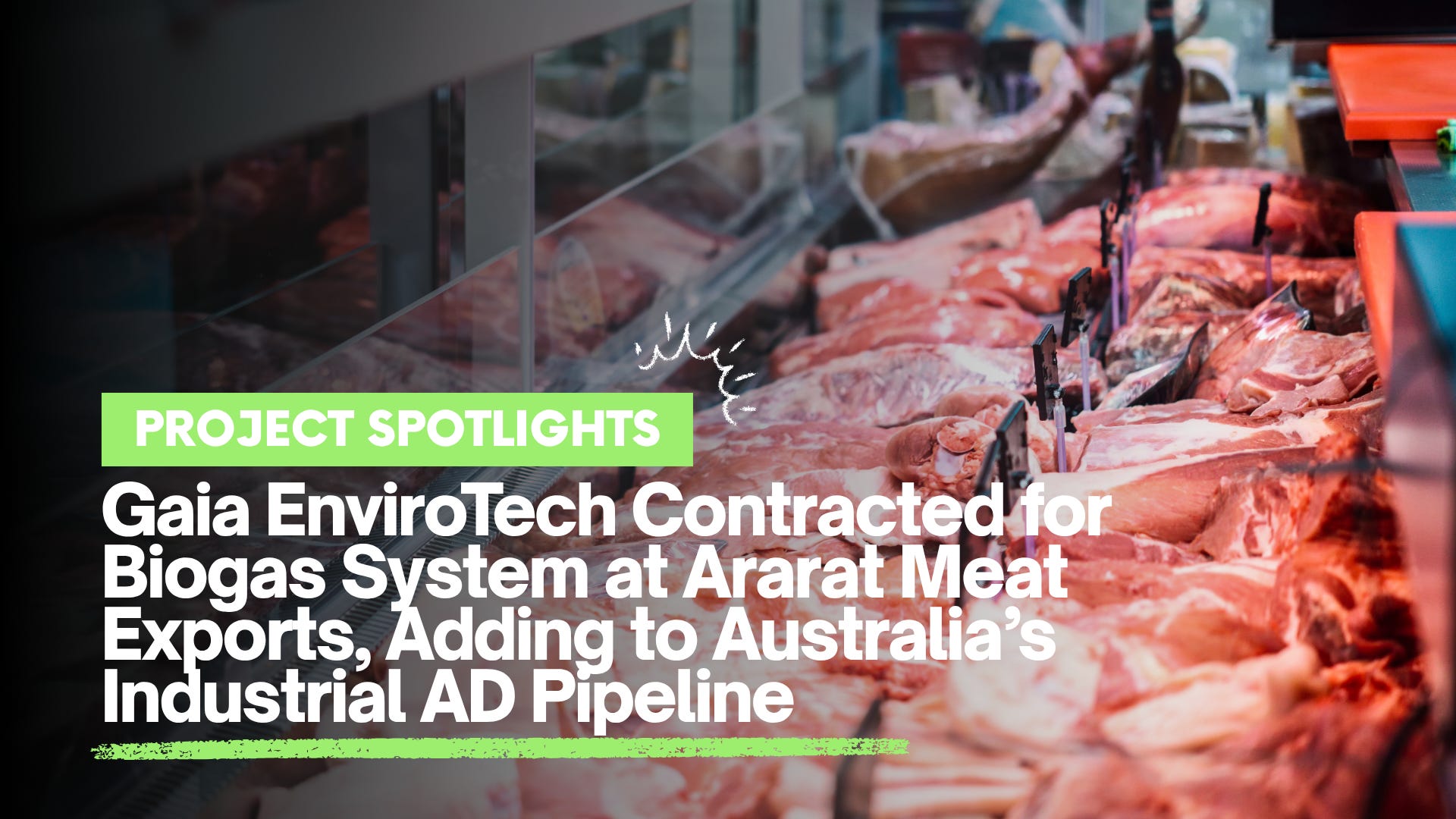
Gaia EnviroTech Contracted for Biogas System at Ararat Meat Exports, Adding to Australia’s Industrial AD Pipeline
🇦🇺 Australia | West Vic News
Ballarat-based bioenergy and waste management company Gaia EnviroTech has been contracted to build and maintain a renewable biogas energy system for Ararat Meat Exports, Victoria’s largest mutton abattoir, which processes over one million livestock annually. The project adds another data point to a consistent pattern emerging in the Australian meat processing sector: industrial facilities treating their organic waste streams as energy assets rather than disposal liabilities. Read alongside the Casino Food Co AD facility that broke ground in northern New South Wales last week, and the broader context of the Australia biomethane moment explored in our recent exclusive, what is visible is a sector-wide shift in how abattoirs and food processors in Australia are framing their operational footprint. The technology is modular and proprietary. The context is a national AD infrastructure pipeline that is building site by site, deal by deal, across the industrial food processing landscape.
Divert Opens Washington State Facility, Backed by Mitsubishi Series C, as Food Waste-to-RNG Model Scales
🇺🇸 United States | Waste Dive
Divert has opened its Integrated Diversion and Energy Facility in Longview, Washington, the first of its kind in the state, designed to process up to 100,000 tonnes of unsold and non-donatable food annually using high-recovery depackaging technology and anaerobic digestion. At full capacity, the facility will produce over 235,000 MMBtu of RNG annually through an interconnection agreement with Cascade Natural Gas, alongside 450,000 pounds of digestate fertiliser. The opening coincides with the announcement of a Series C funding round led by Mitsubishi Partners, valuing Divert at over $1 billion. As part of the partnership, Mitsubishi secured preferred offtake rights for RNG at future Divert facilities. Longview is Divert's second integrated depackaging and digestion site, following its Turlock, California plant in late 2024. The dual news, facility opening and billion-dollar valuation, is significant: it confirms that the vertically integrated food waste-to-RNG model, which combines retail network relationships, depackaging technology, and AD infrastructure under one operator, is now commercially validated and attracting institutional capital at scale.
Pig Waste Biogas Pilot Transforms Daily Life for 20 Small Farmers in Pernambuco
🇧🇷 Brazil | Notícias Agrícolas
A pilot project in the Agreste Meridional region of Pernambuco has equipped 20 small pig farmers with biodigesters converting swine waste into biogas for cooking and biofertiliser for crops, funded by Sebrae-PE and the Agência de Desenvolvimento Econômico de Pernambuco at a total investment of R $327,000. Farmers report eliminating or significantly reducing their spending on bottled gas and charcoal, while digestate is being applied to crops including fodder palm and maize. One farmer describes a direct reinvestment loop: gas savings funding additional pig purchases, which produce more waste, which produces more gas. What this pilot demonstrates is not a technology story but an economics story at a scale that national biogas statistics routinely obscure: for small-scale agricultural producers, biogas is not an energy transition technology, it is a household economics intervention. The circularity is not theoretical; it is being lived.
Tech, Science & Innovation
Syzygy’s Uruguay NovaSAF-1 Begins Design Phase, Advancing the World’s First Electrified Biogas-to-SAF Plant
🇺🇾 Uruguay | Bioenergy Insight
Syzygy Plasmonics has initiated front-end engineering and design for NovaSAF-1 in Durazno, Uruguay, the world's first fully electrified facility converting biogas into sustainable aviation fuel. The plant will use cow manure-derived biomethane and CO₂ from Estancias del Lago's dairy operations combined with Uruguay's near-100%-renewable electricity grid to produce over 350,000 gallons of ASTM-certified SAF annually, with a carbon intensity reduction exceeding 80% versus conventional Jet-A. A six-year offtake agreement covering 100% of production has been secured with Trafigura. Syzygy's process, using its proprietary light-driven Rigel Reactor, bypasses the expensive pre-processing steps that make most biogas-to-SAF pathways economically marginal, claiming yield rates more than 50% higher than conventional thermal biogas reforming. The FID is targeted for Q4 2026. What NovaSAF-1 represents is a genuinely new model for biogas asset economics: one that routes organic waste not into the gas grid but directly into one of the most commercially valuable and supply-constrained fuel markets on the planet. If it performs as designed, it becomes a replicable template for the 50,000+ biogas sites globally that currently lack a viable high-value output pathway.
Biogas-to-Hydrogen Could Halve Production Costs Versus Electrolysis, Webinar Analysis Finds
🌍 Global | gasworld
Analysis presented at a recent industry webinar suggests that biogas-to-hydrogen production pathways could potentially halve costs relative to water electrolysis, positioning biogenic hydrogen as a materially competitive route at current technology and energy price configurations. This is a framing worth taking seriously. Green hydrogen via electrolysis has been the dominant narrative in the hydrogen transition, but cost trajectories have proven slower than projected, and electrolysis economics remain highly sensitive to renewable electricity prices. Biogas-to-hydrogen, which leverages existing feedstock streams and established AD infrastructure, does not carry the same electricity cost exposure. What the analysis points toward is a scenario in which the AD sector's existing asset base becomes an input for the hydrogen economy, not as a replacement for electrolysis, but as a cost-competitive parallel pathway serving different geographies and feedstock contexts. The conversation between biogas and hydrogen is becoming commercially relevant rather than merely theoretical.
Life Cycle Research Confirms Anaerobic Digestion as the Optimal End-of-Life Route for Hemp Biocomposites
🇰🇷 South Korea | EurekAlert
Research published in the Journal of Bioresources and Bioproducts, conducted by researchers at the Korea Research Institute of Chemical Technology, has used full cradle-to-grave life cycle assessment to evaluate disposal options for hemp hurd-based biocomposite films, packaging and agricultural mulch materials designed as petroleum plastic substitutes. Among four end-of-life scenarios tested, anaerobic digestion delivered the lowest global warming potential: for every kilogram of mulch film treated, AD mitigated approximately 6.1 kg of CO₂ equivalent, with biogas converted to electricity and digestate reused as a soil conditioner. The finding is relevant well beyond hemp biocomposites. As bio-based materials proliferate across packaging and agricultural applications, the disposal pathway question becomes structurally important: the environmental case for these materials depends significantly on what happens to them at end-of-life. This research adds peer-reviewed weight to the argument that AD infrastructure is not just an energy asset, it is a critical material recovery system for the circular bioeconomy. The two are not separate value propositions. They are the same system.
DOE Announces $20.2M for Mixed Algae Conversion Research, Extending the Biogas Feedstock Frontier
🇺🇸 United States | Department of Energy
The US Department of Energy's Bioenergy Technologies Office and Office of Fossil Energy and Carbon Management have announced $20.2 million in funding for 10 university and industry projects under the MACRO program, Mixed Algae Conversion Research Opportunity, targeting the conversion of seaweeds and other wet waste feedstocks into low-carbon fuels and bioproducts. The research specifically addresses the variability, chemical complexity, and storage instability of algal feedstocks that have historically limited their commercial viability in bioenergy applications. Two focus areas are covered: conversion of seaweeds to low-carbon fuels and bioproducts, and utilisation of CO₂ emissions from industrial facilities to grow algae for value-added agricultural outputs. What this funding signals is that the feedstock frontier of the broader biogas and renewable gas sector is being actively pushed beyond the well-established streams of agricultural residues, food waste, and wastewater. Algae and wet waste represent an abundant, currently underutilised resource category. If conversion challenges are resolved at research scale, the implications for national and global biomethane supply potential are significant.
Expansion & Trends
Biogas Meets the Data Center Boom: Federal Tax Credits Are Reshaping the Clean Power Investment Case
🇺🇸 United States | JD Supra
Analysis from JD Supra examines how the updated Investment Tax Credit under Section 48E and Production Tax Credit under Section 45Y of the US Internal Revenue Code are reframing the economics of biogas-to-electricity for data center power applications. The convergence of two trends is doing the analytical work here: data centers require dispatchable, always-on baseload power that solar and wind cannot provide reliably, and biogas-to-electricity offers exactly that profile, continuous, grid-compatible, and increasingly cost-competitive at approximately $0.07 per kWh. The federal tax credit framework, when applied to biogas electricity generation, strengthens the investment case materially. This is not a theoretical application: AI-driven data center demand is already stressing grid capacity in key markets like Virginia, New Jersey, and Texas, where interconnection barriers have delayed solar and wind uptake. The combination of demand urgency, dispatchable power characteristics, and improved tax credit access is opening a new demand channel for biogas-to-power infrastructure that has not previously been available at this scale.
Zambia's Nkhundye Community Biogas Project Demonstrates the Village-Scale Model in Practice
🇿🇲 Zambia | Mongabay
A biogas plant managed by the Nkhundye Community Cooperative in Zambia's Eastern Province is serving approximately 100 households, processing cattle dung from a communal kraal of around 300 head through a biodigester that produces methane for cooking, electricity for lighting and device charging, and energy for irrigation pumps supporting year-round vegetable production. The digestate, approximately 2.5 metric tonnes per week, is applied as organic fertiliser, creating a closed material loop across energy, water, and food production. The cooperative intends to expand from 100 to 600 households, with the kraal being scaled to 1,000 head of cattle to support increased production. The project was initially funded by German NGO support through NACRO, with ongoing technical assistance from ILO, UNDP, and UNICEF. Future funding pathways remain unclear, a recurring structural challenge for community-scale biogas that underlines what this month's exclusive essay addresses directly: the technology works; what is missing is the institutional architecture to sustain, verify, and finance it at the scale it is needed.
Brazil's Underdeveloped Gas Pipeline Infrastructure Is the Primary Constraint on Biomethane Sector Growth
🇧🇷 Brazil | Fitch BMI
Fitch BMI analysis identifies underdeveloped gas pipeline infrastructure as the primary structural constraint on Brazil's biomethane sector growth trajectory, a counterintuitive finding given that Brazil closed 2025 with over 1,800 biogas plants and strong production growth. The constraint is not in production capacity but in distribution connectivity. Without grid access, biomethane produced at scale must be transported by road in cylinders, a logistics model that caps project economics and limits addressable markets. Brazil's Fuel for the Future legislation has established a biomethane blending mandate, starting at 1% of natural gas company emissions reductions in 2026, creating demand signals. But demand mandates without distribution infrastructure create a policy gap that feedstock availability and production capacity cannot close alone. This analysis, read alongside the PNGRB's grid injection guidelines just approved in India, is a useful comparative signal: both countries are at a similar inflection point in biomethane market formation, and both are discovering that the physical infrastructure layer is the binding constraint that policy ambition cannot substitute for.
Evonik Partners with Malaysian Biogas Upgrader MTCO to Supply SEPURAN Membrane Technology Across Asia
🇩🇪 🇲🇾 Germany / Malaysia | Filtration & Separation
Evonik Industries has signed a large-scale agreement to supply its SEPURAN Green membrane technology to MTC Orec Sdn Bhd, a Malaysian biogas upgrading plant producer co-owned by VentureTECH, positioning the partnership as a platform for biogas upgrading expansion across Southeast Asia and beyond. Evonik's SEPURAN Green membranes, deployed in more than 2,000 upgrading plants globally, convert raw biogas into high-purity biomethane, including LNG-quality output, at relatively low energy consumption. MTCO specialises in designing and building upgrading plants and has stated ambitions to become the central hub for bioenergy infrastructure in Southeast Asia. What this partnership represents is the transfer of proven European upgrading technology into an underserved market at the moment when regional biogas feedstock and policy conditions are beginning to align. Southeast Asia's potential biogas resource base, agricultural residues, palm oil effluent, municipal waste, is enormous and largely uncaptured. Technology partnerships of this kind are how that resource base begins to become accessible infrastructure.
We Are Biogas is a curated weekly newsletter covering the global biogas, biomethane, RNG, and anaerobic digestion landscape.
Want to be featured? Email: alexandra@wearebiogas.com