


Policy & Capital
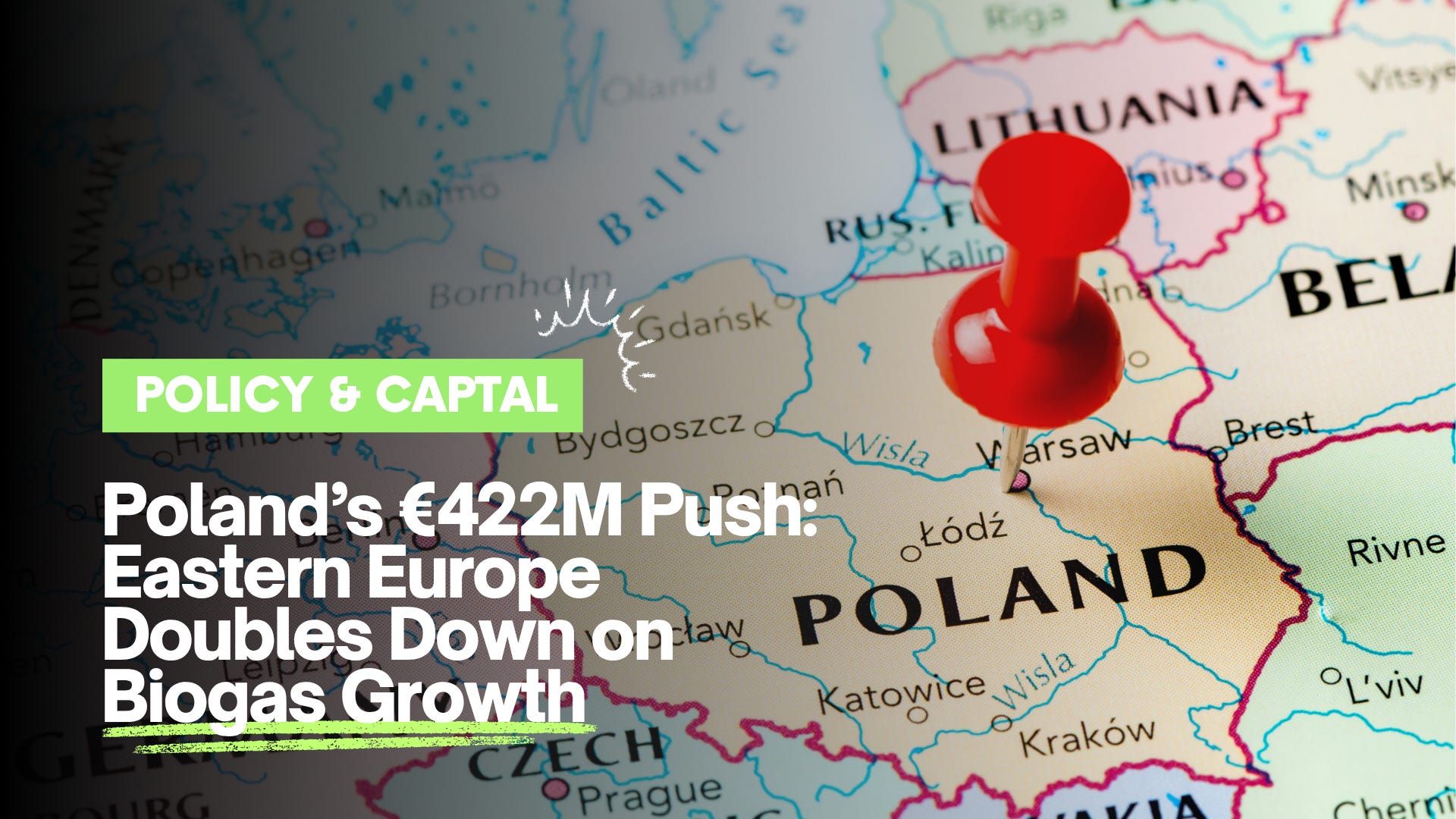
Poland’s €422M Push: Eastern Europe Doubles Down on Biogas Growth
🇵🇱 Poland | Renewables Now
Poland’s €422 million biogas allocation is part of a broader regional pattern where Eastern European countries are using renewable gas to simultaneously address energy security, agricultural waste management, and domestic fuel substitution. What matters here is timing: these investments are being made while infrastructure standards, EU alignment mechanisms, and gas grid integration frameworks are still evolving, meaning early movers will likely shape long-term system architecture. Rather than isolated project funding, this is beginning to resemble state-led market formation.

Biogas Reimagined: Brazil Turns Itaipu Into a Living Innovation Hub for Energy Sovereignty & Research
🇧🇷 Brazil | eixos
Itaipu Binacional has relaunched its biogas and biofuels demonstration unit with a significantly expanded mission, shifting from a production-focused facility to a multi-purpose innovation and research hub designed to attract universities, companies, and technology developers. The site, now positioned as the “Biocombustibles Demonstration Unit,” is explicitly designed for testing next-generation applications of biogas and biomethane, ranging from renewable aviation fuels (SAF pathways) to hydrogen, synthetic fuels, and fertiliser production. This comes at a time when Brazil is increasingly framing biogas within a broader energy sovereignty narrative, positioning domestic renewable fuels as a way to reduce import dependency while strengthening national industrial capacity.
€3.7B Greenlight: Czech Republic Goes All-In on Biomethane Transformation
🇨🇿 Czech Republic | The Brussels Times
The EU’s approval of a €3.7 billion state aid package for Czech biomethane is less about volume and more about policy maturity. What’s notable here is that funding is not limited to CAPEX deployment. It explicitly includes long-term operational support, which is where most renewable gas strategies typically fail or stall. This effectively moves biomethane out of the “build phase” and into a managed infrastructure asset class, aligned with broader EU decarbonization targets while attempting to reduce fragmentation across national markets. The deeper signal is that the EU is integrating biomethane into core energy system planning alongside electrification.
Ireland Exposes a Structural Issue: Biomethane Growth Outpacing Regulatory Alignment
🇮🇪 Ireland | Agriland
Ireland’s biomethane sector is running into a familiar constraint: national-level deployment ambition moving faster than policy coherence. The underlying issue is not opposition to biomethane itself, but the absence of harmonized definitions, environmental thresholds, and approval pathways across jurisdictions, creating friction at exactly the point where projects need certainty. This is less a country-specific issue and more a stress test of how fragmented regulatory systems handle rapidly scaling low-carbon gas markets.
Project Spotlights
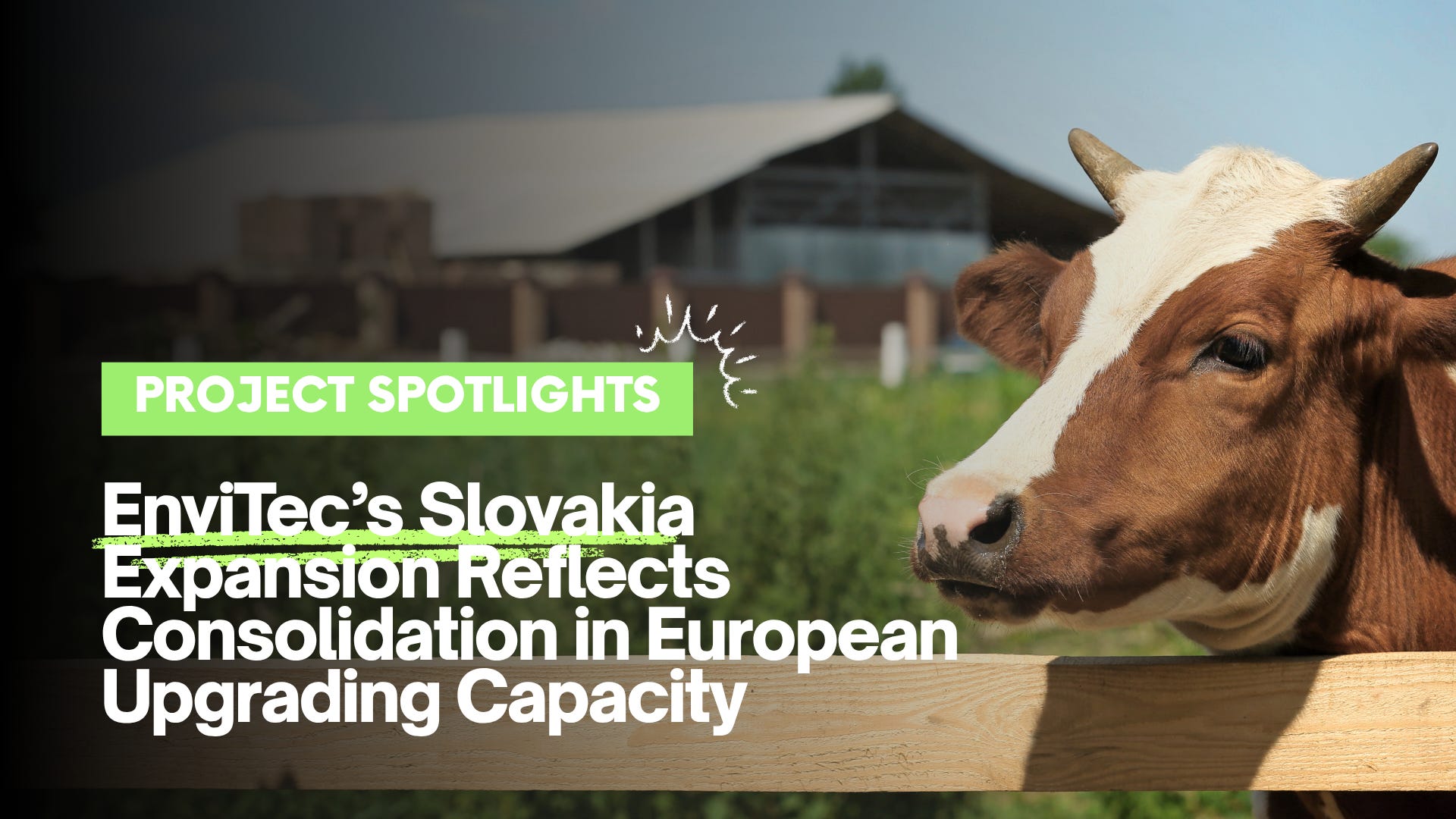
EnviTec’s Slovakia Expansion Reflects Consolidation in European Upgrading Capacity
🇸🇰 Slovakia | Bioenergy Insight
EnviTec Biogas has brought its second biomethane upgrading project online in Slovakia, with the EnviThan system now processing biogas from an existing facility in Ožďany operated by CITA VIA. The underlying biogas plant has been running for over a decade, originally focused on electricity generation using agricultural inputs like maize silage and manure. With the integration of upgrading, the site is now transitioning into a dual-output system, producing both power and grid-quality biomethane. Slovakia currently has a relatively small biomethane footprint, yet analysis suggests dozens of existing biogas plants could be retrofitted for upgrading. The plant is currently upgrading 750 Nm³/h of biogas, with plans to scale toward 1,300 Nm³/h, effectively increasing the value extracted from the same feedstock base.
UK AD Site-Visits Highlight the Growing Role of Social License in Infrastructure Development
🇬🇧 United Kingdom | Linolnshire World
Proposed anaerobic digestion plants in Lincolnshire are undergoing councillor-led site visits as part of the formal planning process, bringing local governance directly into infrastructure decision-making. This reflects a broader trend across the UK where AD deployment is increasingly shaped not just by technical approval, but by social license to operate and local acceptance dynamics. As biogas infrastructure scales, public perception is becoming an embedded regulatory layer, not informal, but structurally influential in project approval timelines.
On-Site Liquefaction Represents a Structural Push Toward Decentralized Biomethane Economies
🇫🇷 France | LNG Industry
Sublime Energie is deploying a system that liquefies biogas directly at farm level, eliminating the need for centralized upgrading and transport infrastructure. This enables producers to convert biogas into transportable liquid fuel at source, fundamentally changing the logistics and economics of small and mid-scale production sites. This directly challenges the assumption that biomethane scaling requires large, centralized infrastructure. It opens the door to distributed production networks with materially lower entry barriers.
Tech, Science & Innovation
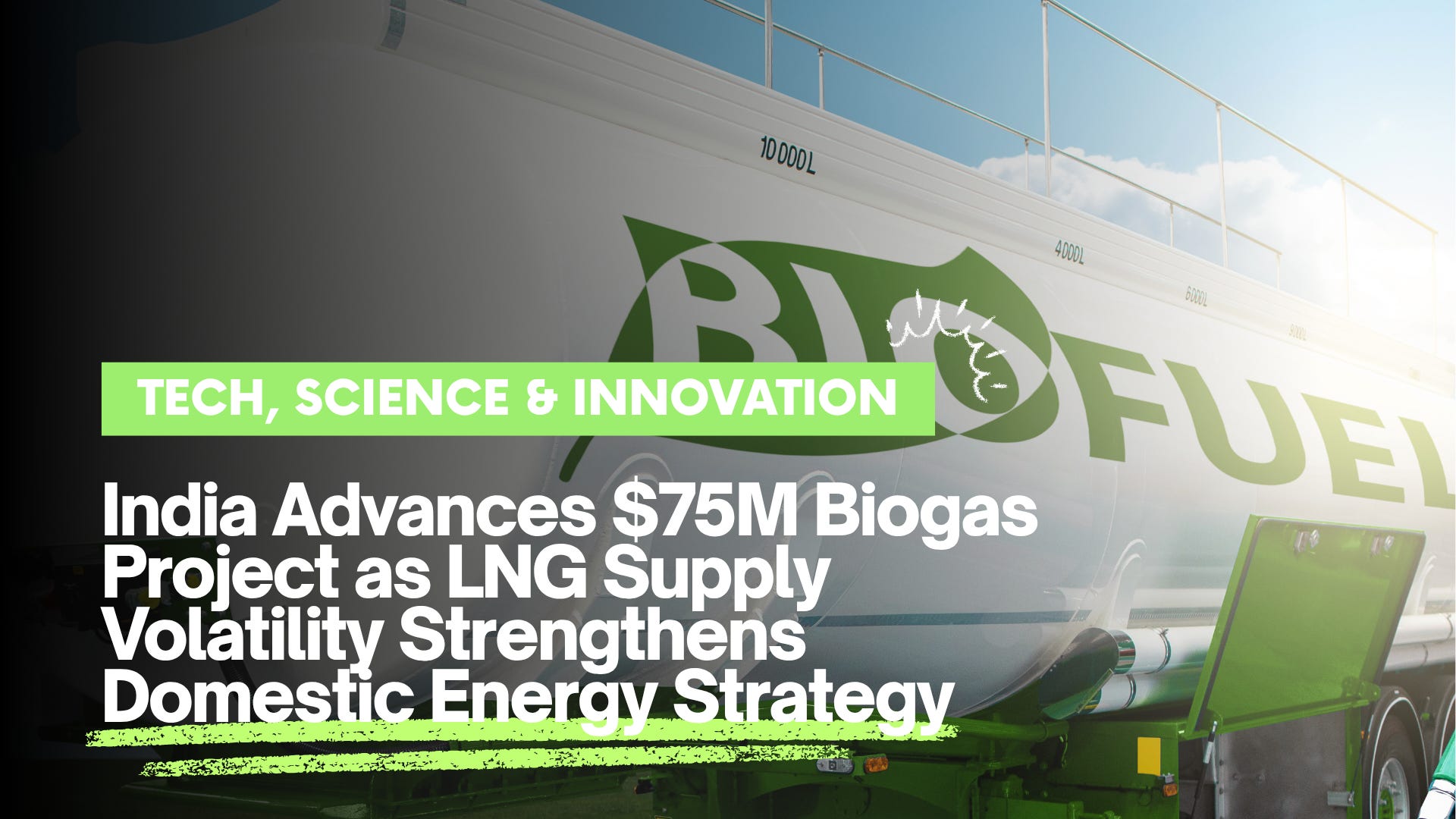
India Advances $75M Biogas Project as LNG Supply Volatility Strengthens Domestic Energy Strategy
🇮🇳 India | gasworld
India is accelerating a $75 million biogas initiative as part of a broader effort to reduce exposure to volatile global Liquified Natural Gas (LNG) markets. The project reflects a growing strategic shift toward domestically controlled energy systems, particularly in sectors vulnerable to import pricing shocks and supply disruptions. The project is structured around a cluster-based model, where multiple interconnected plants collectively process agricultural residues, including paddy straw, cattle manure, and poultry waste, into compressed biogas. Instead of relying on a single large facility, this distributed approach allows feedstock to be sourced locally and processed closer to origin, improving logistics and consistency of supply. At full capacity, the network is designed to deliver around 100 tonnes of compressed biogas per day and will be rolled out in three stages, with the first facilities expected to come online in May 2027 and full completion targeted between 2029 and 2030.
Telkom Indonesia & PGN Position Biomethane as a Viable Energy Source for Data Centers
🇮🇩 Indonesia | Indonesia Business Post
Telkom Indonesia and state gas company PGN are advancing a biomethane initiative aimed at powering low-carbon data centers. One of the fastest-growing and most energy-intensive infrastructure segments globally. The key challenge in data centers is not just decarbonisation, but reliability. Biomethane offers a dispatchable, grid-compatible solution that can operate alongside or in place of conventional natural gas systems. This signals a new demand frontier. As digital infrastructure scales, biomethane is being positioned as a firm, low-carbon energy source for always-on systems. A role intermittent renewables like solar and wind struggle to fill alone.
Expansion & Trends
From $50B to $109B: Global Biogas Market Outlook Reinforces Long-Term Structural Growth Through 2036
🌍 Global | Access Newswire
The latest analysis from Future Market Insights puts the global biogas market at $50.3 billion in 2026, with projections reaching $109.6 billion by 2036, representing a steady 8.1% CAGR. Long-term forecasts show strong growth contributions from Brazil, Germany, and wider European markets. The underlying driver is convergence: waste management policy, agricultural integration, and gas decarbonization targets are increasingly overlapping into a unified demand structure. This is not cyclical energy investment, it is structural system replacement across multiple sectors at once.
Suzuki Integrates Biogas into Mobility Strategy Through Agricultural Waste Partnerships
🇮🇳 India | New Straits Times
Suzuki Motor Corporation is doing something much more strategic than simply “producing biogas” in India; it’s actively building a closed-loop fuel ecosystem that connects agriculture, energy production, and vehicle demand. At its Bhukhala, Gujarat site, the company is processing up to 100 tonnes of cow dung per day, converting it through anaerobic digestion into compressed biogas suitable for transport fuel. The output, around 1.5 tonnes daily, is enough to power roughly 850 vehicles, feeding directly into a local refuelling station.
Ukraine–Germany Biomethane Trade Marks Early Formation of a Cross-Border Renewable Gas Market
🇺🇦 → 🇩🇪 Europe | The Odessa Jorunal
Ukraine is preparing to export biomethane to Germany under emerging bilateral energy cooperation frameworks. This development is less about volume and more about infrastructure alignment: certification systems, transport pathways, and regulatory compatibility. Cross-border trade is the foundation of a functioning biomethane market. Without it, the sector remains fragmented and locally constrained.
“Since Ukrainian steel is produced partly from scrap using electricity without coal generation, the EU’s CO₂ emissions assessment may be overstated. We expect German expertise to help resolve this issue more quickly and unblock exports.”
Oleksii Sobolev
Minister of Economy, Environment, and Agriculture
Sagepoint Energy Deploys 60 RNG Trucks, Strengthening Heavy-Duty Transport Demand for Renewable Gas
🇺🇸 United States | Waste Today
Sagepoint Energy is expanding its renewable natural gas fleet with 60 trucks powered by RNG, reinforcing transportation as one of the most established demand channels for biomethane. Heavy-duty transport remains one of the few sectors where biomethane is already cost-competitive and operationally scalable without major infrastructure redesign. Demand-side adoption, not just production, is what ultimately stabilizes the biomethane value chain. Transport remains a critical anchor market.
“We aren't just acquiring trucks, we’re establishing a new model for doing business in both the energy and heavy-duty trucking markets. By pairing the most advanced engine technology in the world with our own RNG production, Sagepoint is achieving a level of vertical integration that provides our partners with unmatched reliability and environmental stewardship at a low and predictable cost. This is a defining moment for our company and a clear signal to the industry that high-performance logistics and fuel independence are now a reality.”
Aaron Johnson | CEO
Sagepoint Energy
Sindhudurg’s 9,000 Biogas Plants Show What Scaled, Decentralised Energy Actually Looks Like
🇮🇳 India | Hindustan Times
Sindhudurg district has deployed over 9,000 biogas plants across 276 villages, providing a decentralized alternative to Liquefied Petroleum Gas (LPG) as supply disruptions and price volatility continue to impact rural communities. This is not a pilot or demonstration, it’s a functioning energy system built on local resources, delivering daily utility at scale. This is a clear example of biogas operating as primary infrastructure, not supplementary energy, demonstrating how decentralized systems can outperform centralized fuel supply chains under stress.
We Are Biogas Exclusive
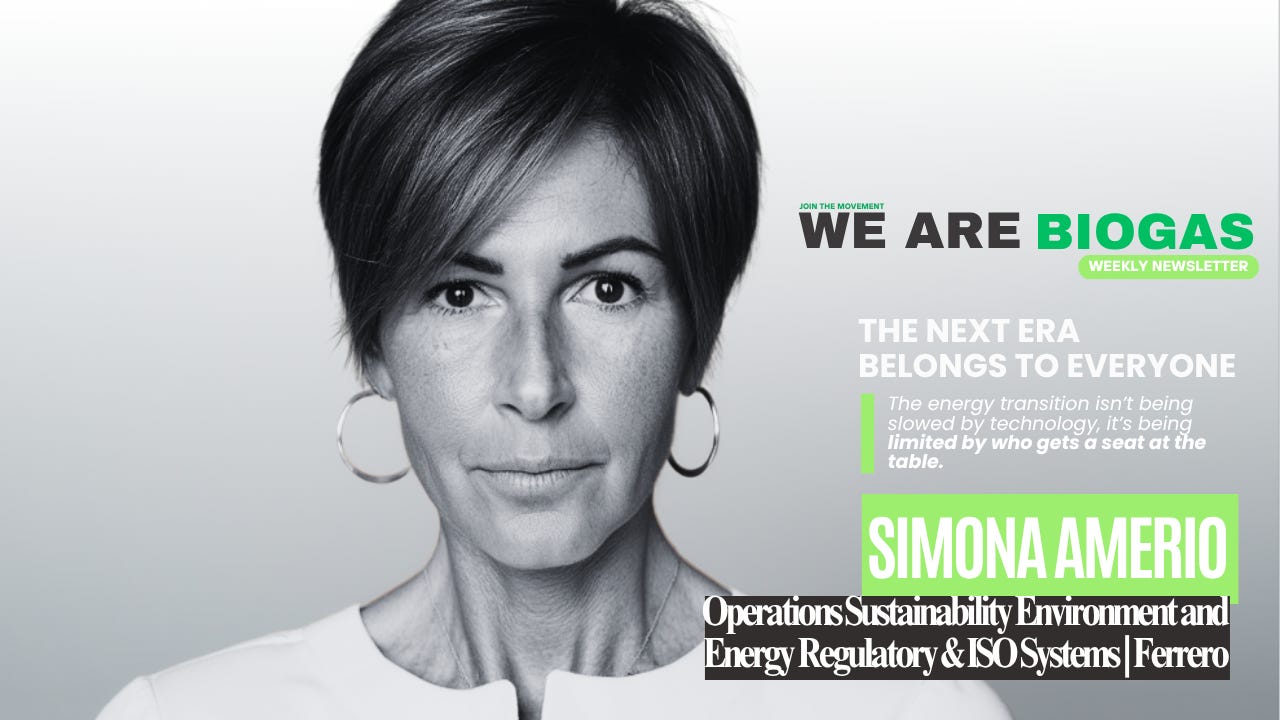
The Next Era Belongs To Everyone: The Gender Diversity Gap Slowing the Energy Transition
By Alexandra Arndt · April 19
In this week’s exclusive, we move beyond technology, policy, and capital to examine a less visible, but equally decisive, constraint on the energy transition: who is in the room when decisions are made. At the center of the conversation is Simona Amerio, an internationally recognised leader operating at the intersection of sustainability, energy systems, and regulatory strategy at one of the world’s largest global companies, Ferrero. With over two decades of experience shaping how complex organisations integrate sustainability into real-world operations, and a recipient of the EBA SheLeads Award 2025, her perspective is grounded in execution at scale. What follows is a candid exploration of the growing gap between the industry’s belief in diversity and its actual implementation. What emerges is a reframing of the issue as execution, performance, and lost potential at a system level. The speed, quality, and resilience of the energy transition will ultimately be shaped by the diversity of perspectives building it.
“You already belong here. The sector needs your perspective, your courage, and your vision, even before it fully recognises it.”
Simona Amerio | Operations, Sustainability, Environment, and Energy Regulatory & ISO Systems
Ferrero
Events & Industry Buzz
Global Summit on Non-Renewable & Renewable Energy 2026
🇩🇪 Frankfurt, Germany | 📅 April 23–25, 2026
The Global Summit on Renewable and Non-Renewable Energy 2026 brings together researchers, policymakers, and industry leaders across the full energy spectrum, from fossil transition pathways to cutting-edge renewable systems. With sessions spanning waste-to-energy, hydrogen, circular economy, and bioenergy systems.
Budapest Biogas Summit 2026
🇭🇺 Budapest, Hungary | 📅 May 8, 2026
With industry leaders, developers, and innovators coming together, The Budapest Biogas Summit 2026 is expected to dive into scaling challenges, regulatory alignment, feedstock optimization, and integration into energy systems. All of the friction points currently slowing deployment across Europe.
BBB International Summit & Expo on Bioenergy Value Chain
🇮🇳 India | 📅 May 7-9, 2026
The BBB Summit 2026 is entering its fifth edition, positioning itself as a central platform for India’s rapidly expanding bioenergy sector. With 300+ delegates, 200+ companies, and 100+ exhibitors, the event brings together stakeholders across the entire value chain. India is a fast-scaling biogas market. Events like this are coordination hubs for policy, capital, and infrastructure rollout at national scale.