


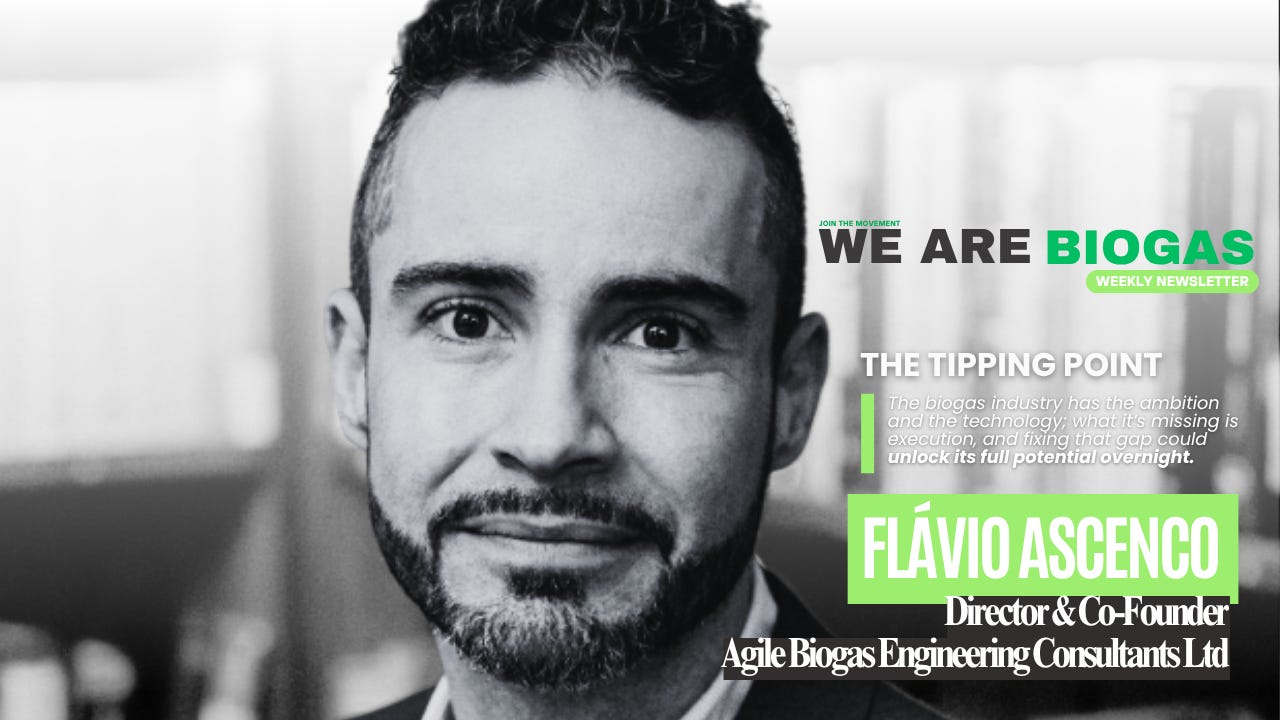
Flávio Ascenco will tell you, with the particular candour of someone who has spent years watching the same avoidable mistakes repeat themselves across continents, that the biogas industry has a consistency problem. That plants fail not because the technology is wrong but because the discipline isn’t there. That the sector is full of passion and short on structure. That an enormous amount of value, environmental, economic, and human, is being left on the table every single day.
He will tell you all of that. And then, almost in the same breath, he will tell you that he has never been more excited about where this is all going.
That combination, clear-eyed about the present, genuinely lit up about the future, is what makes Flávio one of the most useful voices in the global biogas conversation right now. His optimism has been hard-earned: through enough site visits, enough underperforming plants, enough conversations with operators who were never given the training they needed, to know exactly what has been holding the industry back. And because he has spent the last several years building something designed to change it.
Agile Biogas Engineering Consultants exists, in Flávio’s own telling, because there was a gap that nobody else was filling. Not a gap in technology, the technology, he is emphatic, has never been the limiting factor. A gap between ambition and execution. Between the vision that gets a biogas plant funded and the unglamorous, daily, human discipline required to actually run one well.
“I realised there was a gap for a company that could bridge strategy and operations,” he says. “Someone who can sit with senior leadership one day and be out on the digester plant the next.”
That is Agile Biogas. And that gap, once you understand it, explains almost everything about why the sector hasn’t yet delivered on the scale of its own potential, and why people like Flávio closing it matters so much.
The Gap Nobody Talks About
Flávio didn’t come to biogas by accident. He came because the problem was irresistible.
Biogas intersects waste, energy, and agriculture, three sectors that are “messy, human, and essential.” The engineering is intricate. The biology is genuinely humbling. The stakes, for the farms, communities, and food systems that depend on organic waste being managed well, are real and immediate. And underneath all of it is something that Flávio has never stopped finding extraordinary: the idea that what the world treats as a problem, the manure, the food waste, the organic residues that every farm and city and factory produces as a matter of daily life, is actually the feedstock for something enormously valuable.
“Waste is not a burden,” he says. “It’s a resource. Every household, every farm, every factory produces material that can be turned into energy and fertiliser. We’re sitting on an enormous opportunity that most people don’t even see.”
What kept him in the sector, once he arrived, was the gap between that opportunity and what the industry was actually delivering. Plants underperforming for reasons that were entirely fixable. Operators making the same mistakes across different countries because no one had given them the frameworks to make different ones. Organisations with genuine environmental ambition and operations that couldn’t quite translate that ambition into consistent, daily results.
“Even after years in the sector,” he says, “I still see how much value is left on the table.”
For most people, that observation would be discouraging. For Flávio, it is the reason to show up. Every plant that is underperforming for entirely fixable reasons is a plant that could, with the right support, be delivering everything it was designed to deliver. The gap is not a ceiling. It is an invitation.
One Change Could Flip the Industry Overnight
Ask him what the biogas sector is getting right, and the answer is immediate: ambition and innovation. The conversation has moved. Governments, investors, and major energy companies are no longer treating biogas as a niche technology of limited relevance; they are recognising it as strategic infrastructure, essential to decarbonisation, waste management, energy security, and rural economic development simultaneously. The technology itself has matured to a point where, in Flávio’s words, “when plants are run properly, they’re incredibly reliable and efficient.”
That last clause is doing a lot of work. Because the running-properly part is where the industry still has ground to cover, and where Flávio’s focus sits entirely.
The challenge he describes is not complicated, even if solving it requires sustained effort. Biogas is not simple. It’s a biological, chemical, and mechanical system operating simultaneously, and it requires something that the sector has historically underinvested in: operational discipline. Training that reaches operators before they need it rather than after something goes wrong. Accountability structures that outlast the commissioning phase. A shared understanding, at every level of an organisation, of what running a plant well actually demands.
“Technology is never the limiting factor,” he says. “Discipline is. Most failures weren’t because the kit was wrong, but because the basics weren’t being done consistently.”
This is the insight that drives everything Agile Biogas does, and it’s more hopeful than it might first appear. Because if the limiting factor is discipline rather than technology, then the path forward doesn’t require a breakthrough that hasn’t happened yet. It requires doing what already works, more consistently, in more places, with better support for the people doing it.
“If every plant had competent, accountable operators, the sector’s performance would improve overnight.“
Overnight. Not over a decade of incremental improvement. Not pending some future policy framework or capital deployment. Overnight, because the potential is already there, in plants that already exist, waiting to be properly unlocked.
The lessons that travel
One of the things that strikes you about Flávio is the global fluency he brings to this conversation. He’s worked across Europe, Asia, Latin America, and beyond, advising everyone from multinational energy companies to individual farmers planning their first digester. And what he’s found, consistently, is that the surface variables change, the regulatory environment, the culture, the scale, the feedstock, but the underlying dynamics do not.
Europe’s policy frameworks create structure but can also breed complacency, a belief that compliance and performance are the same thing. They aren’t. Asia moves faster, more entrepreneurially, more willing to experiment without waiting for a green light. And then there is Brazil, which Flávio talks about with a particular energy, as a market that understands the link between agriculture, energy, and circularity at a scale and with a pragmatism that the rest of the world is still working to match.
“Projects are built to solve real problems, not to tick policy boxes,” he says. “That mindset is something the rest of the world could learn from.”
What this global vantage point gives him, and what makes Agile Biogas genuinely unusual, is the ability to carry solutions across borders. A lesson learned on a farm in Europe becomes applicable in a municipal facility in Asia. A framework developed for a multinational becomes adaptable for a cooperative. The principles of good operation don’t change with geography. Which means the improvements Flávio is driving in one corner of the world are not isolated wins. They are the blueprint that’s replicable everywhere.
Walk Before The Run
There is a phrase Flávio uses that captures something important about where he stands relative to the urgency the climate moment is creating.
“The industry must learn how to walk before it can run,” he says. “And only when you can run can you explore competition levels such as a 10k, a half marathon, or a full marathon.”
In a moment when the pressure to scale everything faster is intense and legitimate, the idea of getting the foundations right first can sound almost conservative. But Flávio’s point is the opposite of cautious. He is arguing that the path to genuine scale, to thousands of plants running reliably, to biogas recognised as essential infrastructure, to the sector delivering on its full climate and economic potential, runs directly through operational excellence, not around it. Scaling without foundations doesn’t accelerate progress. It replicates failure at volume.
And the destination he is moving toward, once those foundations are in place, is genuinely extraordinary. A world in which the organic waste produced by every farm, every city, every food manufacturer is not a cost to be managed but a resource to be captured. In which biomethane is as unremarkable and indispensable as any other utility. In which the operators who keep these systems running are recognised as the skilled professionals they are, with the training and certification to prove it.
“Success looks like biogas being recognised as essential infrastructure,” he says. “As normal and necessary as water treatment or recycling.”
That vision is within reach. Not in some distant future dependent on technology that doesn’t yet exist, but through work that can start today, in the training programs being built, the operational frameworks being deployed, the standards being shaped, the plants that are right now performing at half capacity and waiting for someone to show up and help them do what they were designed to do.
The People Who Make It Happen
The biogas sector is at an inflection point. The ambition is there. The technology is there. The environmental and economic case has never been stronger. What has been missing, the thing that Flávio has dedicated his career to supplying, is the connective tissue between vision and delivery. The frameworks. The training. The accountability. The people who can sit with leadership one day and be out on the digester plant the next, and who understand, from both vantage points, what it actually takes to make a plant run well.
People like that are rare. The fact that they are building the infrastructure to bring that expertise to scale is one of the most genuinely encouraging things about where this industry is headed.
“Biogas is one of the few industries where you can genuinely improve environmental outcomes and operational resilience at the same time,” Flávio says. “That combination keeps me here.”
A powerful reminder of exactly why this work and the people behind it matter.
For consulting, training, technical input, or project development enquiries, contact Flávio at flavio.ascenco@agilebiogas.com or find out more at agilebiogas.com