



We Are Biogas Exclusive
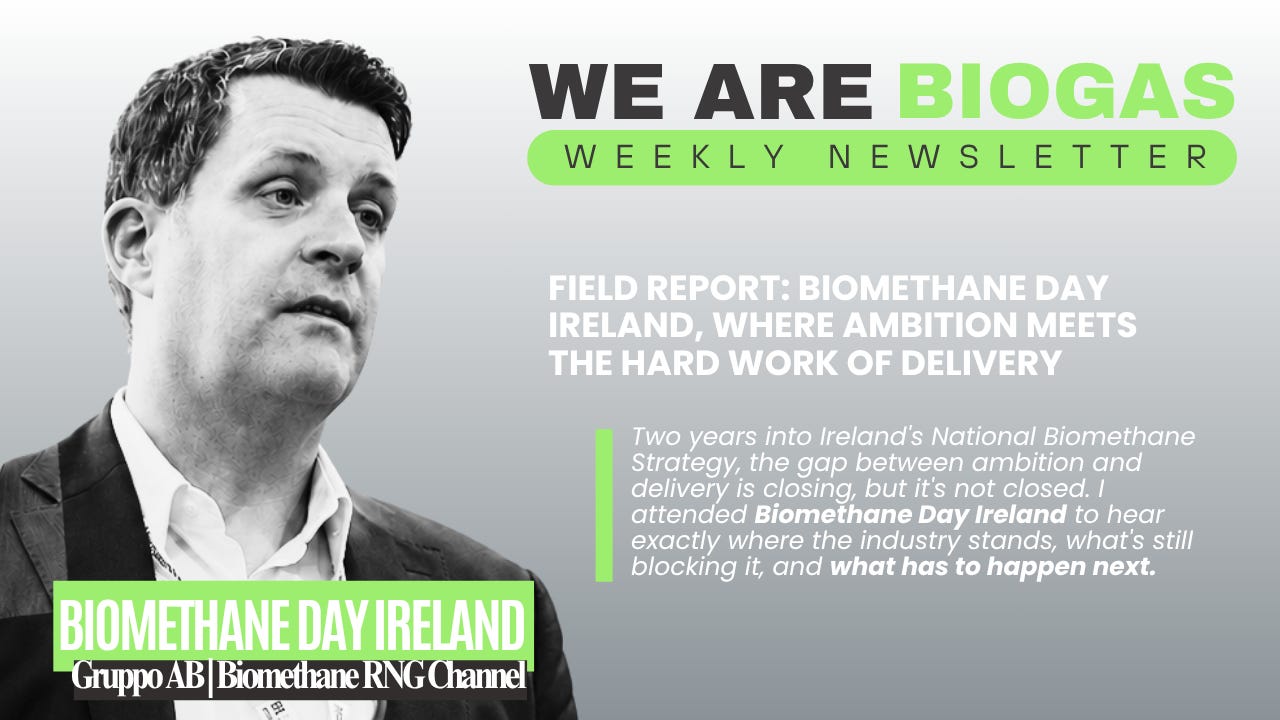
Field Report: Biomethane Day Ireland Where Ambition Meets the Hard Work of Delivery
🇮🇪 Ireland | We Are Biogas
I recently had the opportunity to attend Biomethane Day Ireland, and I left with one overwhelming takeaway: Ireland is standing at a truly defining moment. Organized by Gruppo AB - Energy Sustainability, the event brought together the people building Ireland’s biomethane sector, developers, policymakers, financiers, farmers, and the conversation was less about whether Ireland can do this and more about what’s standing in the way of doing it now.
The honest answer? Not much, and also quite a lot. But there are still gaps between what’s been committed to on paper and what’s been delivered on the ground. Implementation timelines. Support mechanisms. The legislative tools that turn a national strategy into a functioning market.
Richard Kennedy, put it simply: “The time for delivery is now.” And sitting in that room, surrounded by people who have clearly been waiting a long time to hear exactly that said out loud, it landed.
I’m already looking forward to Biomethane Day next year, because if this event was about setting the intention, next year’s should be about measuring the distance traveled.
Policy & Capital
Japan and India Sign a Biogas Vehicle MOU and Target 1,000 Methane Plants
🇯🇵🇮🇳 Japan & India | Japan Times
Japanese Prime Minister Sanae Takaichi and Indian Prime Minister Narendra Modi have exchanged a memorandum of understanding establishing a bilateral framework to promote biogas-powered vehicles in India, with a target of expanding the number of domestic methane production plants for CNG vehicles to 1,000. Suzuki Motor, which holds the largest share of India’s passenger vehicle market, where CNG already accounts for over 20% of new vehicle sales, will cooperate on the initiative and has already begun producing biogas in India under Japan’s Global South support programme. A head-of-government MOU puts biogas into the formal architecture of India-Japan geopolitical cooperation.
Poland’s BGK Commits €25 Million to Pan-European Biomethane Fund
🇵🇱 Europe | Bioenergy Insight
Poland’s state development bank, Bank Gospodarstwa Krajowego, has invested €25 million in SWEN Capital Partners‘ SWIFT 3 infrastructure fund, which targets biogas and biomethane development across Europe and OECD countries. SWIFT 3 is the third vehicle under SWEN’s strategy, launched in 2019. A sovereign development bank deploying capital into a pan-European biomethane fund signals two things simultaneously: that institutional appetite for the sector is maturing, and that Central and Eastern European capital is now actively participating in the European biomethane buildout rather than sitting on the sidelines watching Western Europe invest.
Mumbai Plans a 350-TPD Compressed Biogas Facility One of India’s Largest Urban Biogas Projects
🇮🇳 India | Bioenergy Insight
Mumbai is developing a major compressed biogas facility at Mankhurd, following the signing of a concession agreement between the city’s civic administration and Mahanagar Gas Limited,Avcon Private Limited. The Mumbai Compressed Biogas Project will process up to 350 tonnes of biodegradable waste per day in its first phase, drawing primarily on waste from hotels, vegetable markets, and commercial kitchens. The facility will use anaerobic digestion to produce compressed biogas for transport and industrial applications. India’s largest city, treating its organic waste as an economic feedstock rather than a disposal problem, is a significant signal and an indication of how fast the urban biogas market is maturing across Indian metros.
A Wiltshire AD Project Wins Planning Consent and Shows How Social License Gets Built
🇬🇧 United Kingdom | ENDS Waste & Bioenergy
A 75,000-tonne-per-year biogas project in Wiltshire has received planning consent, adding to a growing pipeline of permitted AD infrastructure in England following the mandatory food waste collection rollout. The project’s consent underlines a wider shift in how AD planning applications are being handled as organic waste diversion becomes a policy priority rather than a discretionary ambition. More consents, more feedstock, more pressure on the infrastructure to exist.
Project Spotlights
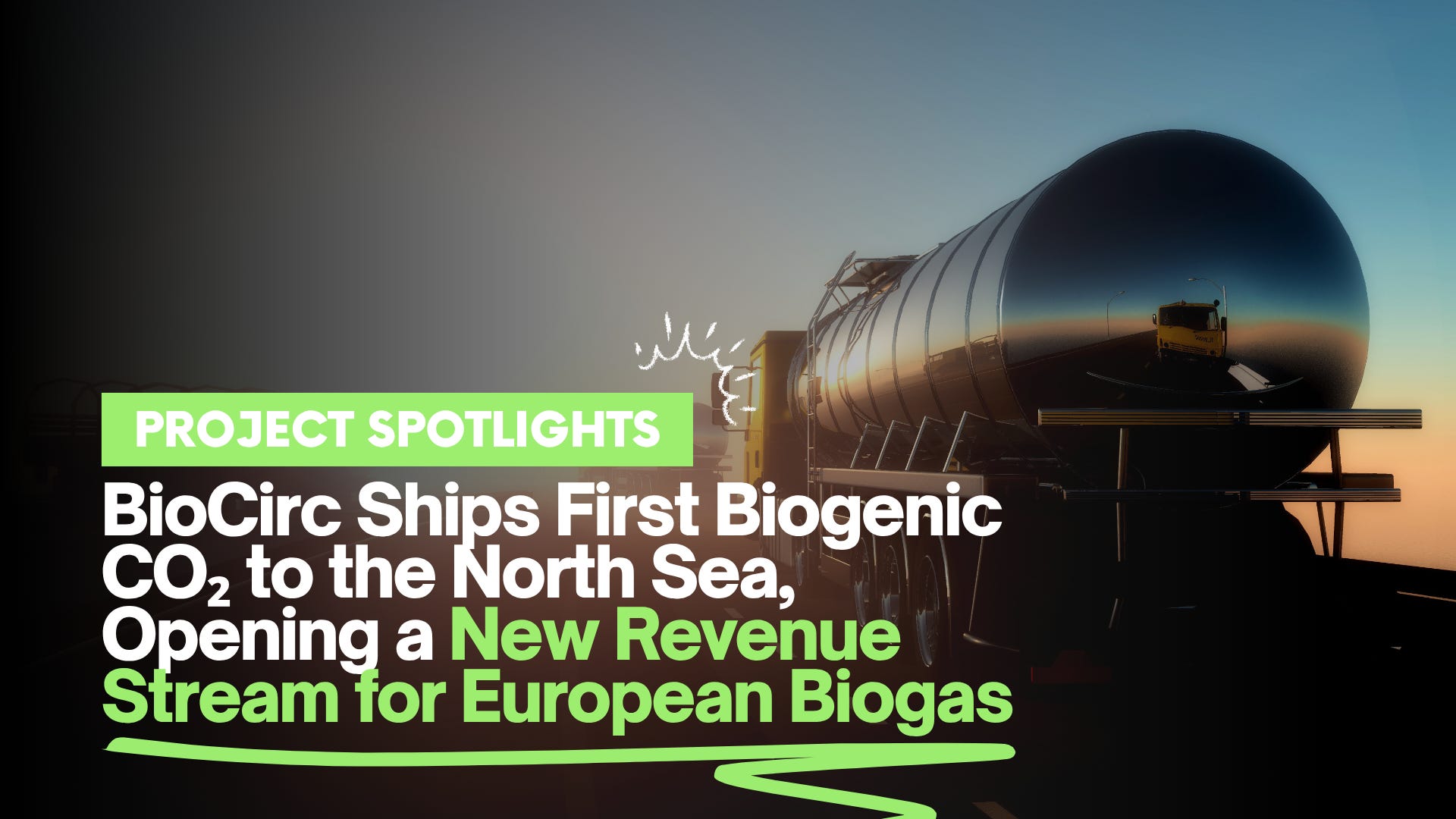
Denmark’s BioCirc Ships First Biogenic CO₂ to the North Sea, Opening a New Revenue Stream for European Biogas
🇩🇰 Denmark | gasworld
Danish biomethane producer BioCirc has announced the departure of the first truck carrying captured biogenic CO₂ from its BECCS facility in Vesthimmerland, the world’s largest biogas-integrated carbon capture and storage facility. The biogenic CO₂ is being liquefied, transported to the port of Esbjerg, and permanently injected beneath the North Sea as part of Project Greensand. The Vesthimmerland plant is the first of five planned BECCS installations across BioCirc’s portfolio, targeting 32,500 tonnes of CO₂ captured annually at this site alone. Last month BioCirc finalized a seven-year agreement to deliver 650,000 tonnes of carbon removal units to Microsoft.
Estonia Opens One of Its Largest Biomethane Facilities in Pärnu County
🇪🇪 Estonia | CEE Energy News
Infortar‘s subsidiary Halinga OÜ has officially opened one of Estonia’s largest biomethane plants in Pärnu County, utilizing agricultural waste to produce renewable gas for grid injection. The facility was built with EnviTec Biogas AG and supported by EU NextGenerationEU recovery funding. Infortar’s chairman noted at the opening that restoring Estonia’s dairy herd to early-1990s levels could theoretically supply the country’s entire gas demand, a statement that captures exactly why biogas’s relationship with agriculture is a structural story, not a project-level one.
Archaea Energy and Republic Services Celebrate First Lightning Renewables RNG Plant in Indiana
🇺🇸 United States | Biomass Magazine
Archaea Energy, a subsidiary of bp, and Republic Services have celebrated the first RNG plant in their Lightning Renewables joint venture, located in Fort Wayne, Indiana, with commercial production expected this summer. The partnership between a major waste management operator and one of the world’s largest energy companies, with Archaea’s technical infrastructure in the middle, is a model for how large-scale RNG development gets structured in the US. When bp’s capital, Republic Services’ feedstock access, and Archaea’s project development capability converge in a single joint venture, the result is the kind of pipeline that doesn’t stop at one plant.
Canada’s First-of-Its-Kind RNG Plant Is Now Fully Operational in Blenheim, Ontario
🇨🇦 Canada | CK News Today
One of Canada’s first renewable natural gas plants is now fully operational in Blenheim, Ontario, described by local coverage as revolutionary for the region. The facility represents a milestone for Canada’s emerging RNG infrastructure, adding to a market that has been developing steadily but remains significantly below its potential relative to the country’s agricultural feedstock base. Canada’s RNG sector is producing real infrastructure now, plant by plant, community by community.
Tech, Science & Innovation
EU’s TITAN Project Validates Microwave Technology That Converts Raw Biogas Into Hydrogen and Solid Carbon
🇪🇺 Europe | Sapo / Hydrogen Central
The Horizon Europe-funded TITAN project, nearing the end of its 48-month research programme, has validated a process that uses microwave energy to convert raw biogas directly into hydrogen-rich gas and solid carbon materials, combining multiple reaction steps in a single system and significantly reducing the need for additional gas treatment and separation. The process simultaneously produces renewable hydrogen and a solid carbon co-product that can support carbon storage. This is a meaningful advance on the conventional biogas-to-hydrogen pathway: fewer processing steps, a dual output, and a potential route to negative emissions. If it scales commercially, it changes the economics of small and remote biogas plants that currently have limited upgrading options.
UFPB Researchers Build Open-Source Software to Calculate the Thermophysical Properties of Biogas
🇧🇷 Brazil | UFPB
Researchers at the Federal University of Paraíba have developed a computer program capable of calculating the thermophysical and energetic properties of biogas, including heat capacity, thermal conductivity, viscosity, and energy density, across variable composition profiles. Developed by the 2EXA research group at CEAR, the tool is designed to help engineers and project developers model biogas behavior more precisely across different feedstock compositions and operating conditions. It’s a technical rather than a commercial story, but it’s the kind of foundational tool that improves project design, reduces uncertainty in performance modeling, and lowers the barrier to entry for smaller operators who don’t have access to expensive proprietary simulation software.
Tracking Melanoidins: New Research Identifies a Compound That’s Quietly Limiting Food Waste Biogas Recovery
🌍 Global | Newswise
A research team from the Chinese Academy of Sciences has clarified how melanoidins, dark compounds formed during the hydrothermal treatment of food waste, accumulate in the anaerobic digestion process and actively interfere with biogas production. Melanoidins are a Maillard reaction product: they form when organic material is heat-treated, and they resist microbial breakdown, building up in digestate and inhibiting the biological processes that produce methane. Knowing that melanoidins are a meaningful inhibitor and being able to track where they accumulate opens a pathway to process design changes that could recover biogas output that’s currently being lost without operators knowing why. The sector gets more from the same feedstock by understanding what’s slowing the biology down.
Decentralised Biogas Model Could Unlock Biomethane for Small Farms Without Requiring Large Capital
🇪🇸 Spain / Global | Bioenergy Insight
Researchers from the Technical University of Madrid have proposed a new business model for biomethane production that pools resources across multiple small livestock farms producing biogas at each site but centralising upgrading infrastructure to achieve the scale needed to make grid injection commercially viable. Published in the journal Sustainable Development, the model addresses one of the most persistent structural barriers in agricultural biogas: the fact that most farms are too small to justify individual upgrading systems, but collectively represent a significant and largely untapped feedstock base. A shared upgrading model doesn’t require every farmer to build a full biomethane system. It requires enough farmers to contribute feedstock to one.
Expansion & Trends
Scotland’s £10 Billion Biomethane Opportunity: 2.5% Utilisation, 19 TWh Potential, and a Sector Calling for a National Target
🏴 Scotland | Energy Digital
A report by the Green Gas Taskforce, supported by SGN and launched at the Royal Highland Show, estimates Scotland could unlock £10 billion in economic value and 8,000 jobs by scaling biomethane production to 19 TWh by 2050, equivalent to roughly half the country’s current gas demand. The number that stays with you is not the upside. It’s this: currently, just 2.5% of Scotland’s organic farm waste is being used to produce biomethane. The resource is there. The technology is proven. The economic case is documented. The gap between what Scotland has and what it’s using is a policy gap, and the taskforce is calling directly on government to fill it with a national biomethane target and the investment framework to match.

We Are Biogas is an independent media platform covering the global biogas, biomethane, RNG, and anaerobic digestion industry. Subscribe to the weekly newsletter and follow the podcast for in-depth coverage, industry interviews, and sector analysis.