



In October 1973, Arab OPEC members imposed an oil embargo on the West, and within weeks, the price of crude quadrupled. In February 2022, Russia invaded Ukraine and severed the pipeline gas supply on which Europe had built a dependency. In February 2026, the United States and Israel launched strikes on Iran, and the Strait of Hormuz, through which roughly 20% of the world’s seaborne oil and LNG transits daily, became impassable for commercial shipping within days. Three crises, five decades apart, structurally similar.
“The war in the Middle East is creating a major energy crisis, including the largest supply disruption in the history of the global oil market. In the absence of a swift resolution, the impacts on energy markets and economies are set to become more and more severe,” IEA Executive Director Fatih Birol.
In each case, a geopolitical decision made in a region that importing nations could neither influence nor control was sufficient to expose the brittleness of systems that had, until that moment, appeared to function perfectly well. In each case, prices spiked, industries faltered, and governments scrambled for emergency measures. In each case, analysts reached for the same word: unprecedented. And in each case, the crisis was not the cause of the vulnerability. It was the occasion on which an existing vulnerability became undeniable.
There is a version of this story that ends differently. Denmark found it after 1973, and the country has lived inside that version ever since. As one of the world’s leaders in energy independence, the Danish answer was not a diplomatic one, nor a military one. It was architectural. The country rebuilt its energy system from the ground up around localised, distributed, domestically sourced fuels, and one of the central pillars of that rebuild was biogas.
As Brent crude crosses 100 USD per barrel and European LNG prices surge in response to Hormuz, the case for that architectural answer has never been more legible. This is not a new argument. It is a recurring one, and the clarifying truth is that the tools to act on it are more mature, more proven, and more economically competitive than they have ever been.
Energy crises do not create vulnerability. They reveal it. The question each crisis poses is the same: what will we choose to do with what it shows us?
1973: The Last Time the Ground Gave Way
The first oil shock is worth examining as historical context and as a diagnostic template, because the pattern it established has repeated with notable fidelity ever since. By the early 1970s, the industrialised world had drifted, with barely a thought, into near-total dependence on Middle Eastern oil. Europe and Japan were sourcing between 60% and 80% of their total energy from that single region. Nobody particularly worried about this because nothing had yet gone wrong, and the comfortable performance of the recent past had been mistaken for structural security.
When the embargo landed, the reckoning was swift and severe. GDP fell 7% in Japan, 4.7% in the United States, and over 2% across Europe. Petrol stations run dry across Europe and North America. Germany bans driving on Sundays. Nixon cuts highway speed limits and floats the idea of ‘Project Independence.’ In Britain, Edward Heath warns the nation to brace for the hardest Christmas since the Second World War. What made the crisis so damaging was not the embargo itself but the decades of structural complacency that preceded it: the industrial world had been wasteful in its energy use, woefully underdeveloped in its conservation measures, and had failed entirely to explore alternatives to the single source on which it had staked everything.
That failure of foresight is what makes 1973 a template. The crisis did not manufacture the dependency; it disclosed it. And disclosure, without the institutional memory to act on what is disclosed, is not the same as a lesson learned.
Denmark Didn’t Just Diversify, They Localised
Most nations responded to 1973 with the policy equivalent of scrambling: strategic petroleum reserves, temporary rationing measures, and new offshore oil exploration. These were responses to the symptom, not the disease. One country, however, took a structurally different approach, and the contrast is instructive.
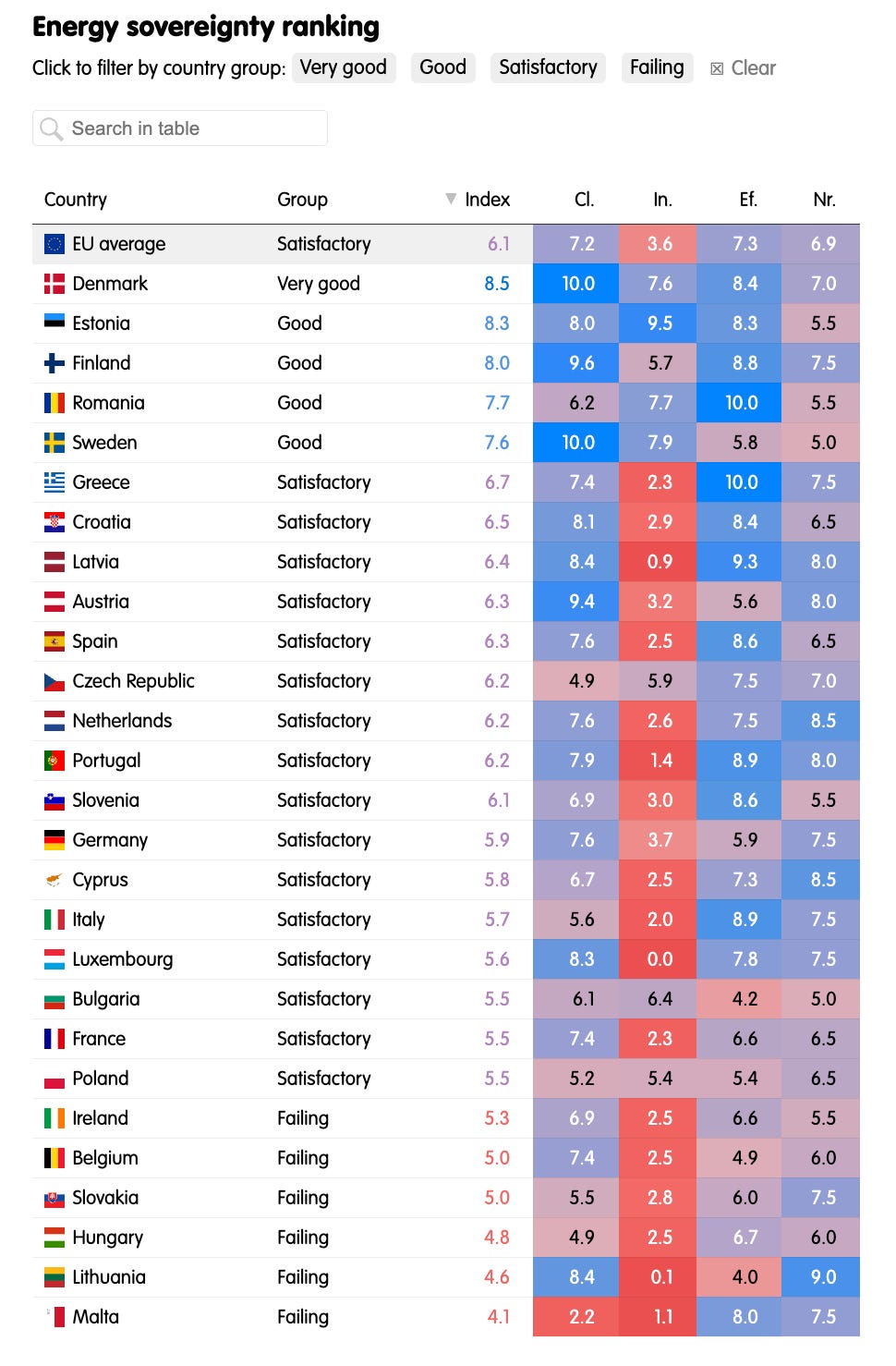
In 1972, an astonishing ~90% of Denmark’s energy supply came from imported oil. The country was, perhaps, more exposed than anyone. Yet where others clambered for a new supplier, Denmark asked a harder and more enduring question: what would it take to never be in this position again? The answer it arrived at was not diversification in the conventional sense, swapping one external dependency for another, but localisation. A fundamental reconception of where energy comes from and who controls it.
Denmark’s 1979 Heat Supply Act established district heating and combined heat and power (CHP) as the backbone of a new national energy architecture. CHP is elegantly simple in principle: generate electricity and capture the heat that would otherwise be wasted, then distribute it through underground pipe networks to homes and businesses. Decentralised CHP plants began appearing in towns, fired not by imported crude but by domestic fuels: natural gas, straw, wood waste, and eventually, biogas. Energy ceased to be something that arrived from thousands of miles away and became something that happened locally, from local resources.
Between 1980 and 2009, the Danish economy grew by 80% while total energy consumption rose by only 13.7%, and carbon dioxide emissions actually fell by nearly 14%. A 1987 biogas action plan brought anaerobic digestion formally into the national energy fold. Denmark had achieved what most economists still treat as hypothetical: a sustained decoupling of economic growth from energy consumption.
What made it work, though, was not technology; it was consistency. The Danes maintained the same overarching policy priorities, energy independence, fuel diversification, efficiency across multiple governments and multiple decades. This matters because policy consistency is, in practice, extraordinarily rare. Most countries manage a crisis, declare it resolved once prices stabilise, and imperceptibly drift back toward comfortable dependency. Denmark refused to do that. That refusal is the actual lesson
We’ve Been Here Before, We Just Didn’t Learn Fast Enough
In 2022, Russia’s invasion of Ukraine severed Europe’s reliance on Russian natural gas, which equated to roughly 40% of its supply at the time, in a matter of months. The parallels to 1973 were not merely suggestive; they were structural. Once again, geopolitical events in a distant region exposed a vulnerability that had been accumulating, unsuspected and unexamined, for years. Once again, prices spiked, industries faltered, and policymakers rushed. The crisis did not build the problem. It made it undeniable.
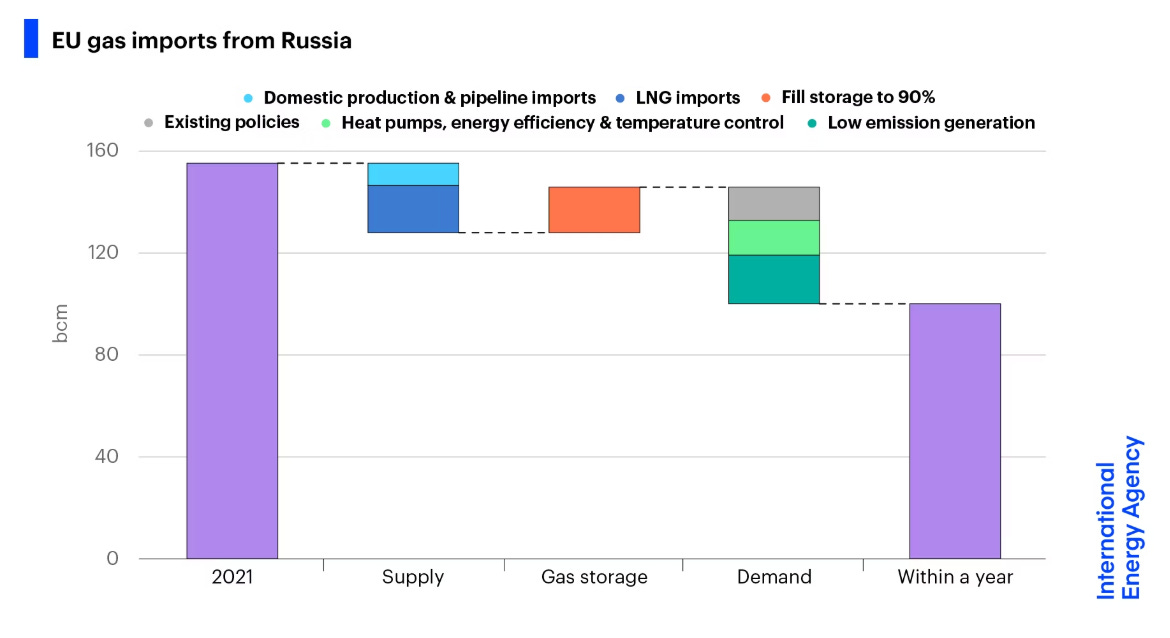
As of 2024, the European Union consumes approximately 332 billion cubic metres of gas annually, of which 273 billion cubic metres are imported. Europe still sources 90% of its gas consumption from external suppliers, leaving its industrial base and consumers structurally exposed to forces entirely beyond its control. A single pipeline decision, a single political rupture, and the wheels come off again.
Resilience is not just about supply. It is about proximity. And Europe, again, is discovering that a system optimised entirely for the cheaper option leaves very little margin for the moments when efficiency is no longer the operative constraint.
Biogas: Local, Circular, Already Operational
This is where biogas enters the conversation. Already operational, already scaling, and already filling the gap that imported fossil gas left behind. It’s worth dwelling on that distinction, because the tendency in energy discussions is to treat renewables as a category of promising aspiration rather than present-day industry. Biomethane does not require that framing.
Biogas is produced through anaerobic digestion, the microbial breakdown of organic matter in the absence of oxygen. The feedstocks are not exotic: agricultural residues, manure, food waste, sewage sludge, and industrial organic by-products. The energy source is, in essence, the waste stream of modern civilisation. When upgraded to biomethane, refined to the same quality as natural gas, it flows directly into the existing gas grid and powers homes, vehicles, and industrial processes without any modification to infrastructure.
The European Biogas Association’s 2025 Statistical Report reveals the current state of play with notable clarity: Europe now produces 22 billion cubic metres of biogas and biomethane annually. There are 1,620 biomethane-producing facilities across the continent, with 86% directly connected to the gas grid. Over €28 billion in private investment has been committed to biomethane development ahead of 2030. By any reasonable measure, this is no pilot program.
The scale of what remains untapped is even more striking. According to the World Biogas Association and IEA analysis, globally, only around 5% of the total sustainable potential for biogas and biomethane production is currently being utilised. The IEA estimates that nearly 1 trillion cubic metres of natural gas equivalent could be produced each year sustainably from today’s organic waste streams alone, equivalent to roughly a quarter of total global natural gas demand. Even the EU, the world leader in this space, harnesses only around 40% of its potential from waste feedstocks. The resource constraint, to be blunt, is not the issue.
We are not lacking resources. We are underutilising them.
Biogas also offers something that wind and solar, by their very nature, cannot: dispatchability. It can be turned on when the sun is not shining and the wind is not blowing. It provides the grid stability that intermittent generation, by definition, cannot guarantee. The EBA’s latest report notes that Europe’s dispatchable power generation capacity has actually declined from 424 GW in 2012 to around 380 GW in 2023, even as the demand for flexible, reliable generation has grown. Biomethane is uniquely positioned to fill that gap, as a fuel and as a grid asset in the most literal sense.
There is also a circular economy dimension that receives far less attention than it deserves. The digestate left over after biogas production is a nutrient-rich organic fertiliser with the potential to replace 17% of the EU’s nitrogen-based fertiliser demand today, and projected sector growth suggests it could substitute over 65% of non-renewable nitrogen in the EU by 2040. This matters enormously when Europe imported 11.2 million tonnes of nitrogen-based fertilisers in 2024, much of it derived directly from fossil fuels. A biogas facility, viewed properly, is not an energy plant with a waste problem. It’s a closed loop, organic matter in, energy and soil fertility out.

The Same Crisis, No Longer the Same Excuses
One of the more enduring observations to emerge from retrospective analyses of the 1973 crisis is that energy policy is not purely an economic matter; it is a matter of security and social continuity. What history does suggest, with some consistency, is that the decisions made in the relative calm between crises tend to prioritise what is immediately available over what is structurally sound, and that the gap between those two things only becomes visible when the next shock arrives. Whether that reflects a failure of markets, of institutions, or simply of political imagination is a question worth examining. What is less debatable is the pattern itself.
The irony of the current moment is that the technology has finally caught up with the lesson history has been trying to teach. In 1973, the alternatives to fossil fuels were nascent, prohibitively expensive, or largely theoretical. There was a genuine structural reason why energy diversification was a generational project. That argument no longer holds. The tools exist, the feedstocks exist, the grid infrastructure exists. What has historically been absent is the sustained political will to treat resilience as an end in itself, not merely a crisis-era priority to be unobtrusively retired when prices fall.
Denmark’s energy transformation illustrated this plainly. The country built a system that was intentionally distributed, locally anchored, and not always the cheapest option in any single year, and it turned out to be spectacularly robust. While other European states rebuilt dependency on a new external supplier, Denmark constructed something that could not be switched off by a foreign political decision. That is the real inheritance of the 1973 crisis.
Biogas, and biomethane specifically, is the natural extension of that logic for the current moment. It’s local by definition, it’s dispatchable, it’s circular, it’s already functioning at scale across 25 European countries, with more entering the market each year.
The EBA’s projections suggest that by 2040, biogases could meet up to 80% of EU gaseous fuel demand. That figure was inconceivable in 1973. It’s a feasible milestone today.
The pattern: crisis, scramble, recovery, complacency, repeat, has now cycled through three iterations in fifty years. Each time, the tools available to break the cycle have been more developed than the last. Each time, the window between crisis and complacency has closed before the structural work was completed. The question, in March 2026, as tankers sit idle outside the Strait of Hormuz and European energy ministers convene emergency sessions, is whether this iteration will be any different.
Energy crises do not create vulnerability. They reveal it; reliably, repeatedly, and at considerable cost. The resources to build something different are not the limitation. The imagination to treat each revelation as the final warning, rather than the latest one, is.
References
1. Wikipedia — 2026 Strait of Hormuz Crisis — https://en.wikipedia.org/wiki/2026_Strait_of_Hormuz_crisis
2. NPR — Iran War: How Traffic Dried Up in the Strait of Hormuz — https://www.npr.org/2026/03/04/nx-s1-5736104/iran-war-oil-trump-israel-strait-hormuz-closed-energy-crisis
3. CNBC — Strait of Hormuz Closure: Which Countries Will Be Hit the Most — https://www.cnbc.com/2026/03/03/strait-of-hormuz-closure-which-countries-will-be-hit-the-most.html
4. CNBC — How Strait of Hormuz Closure Can Become Tipping Point for Global Economy — https://www.cnbc.com/2026/03/11/strait-of-hormuz-closure-shipping-economy-oil.html
5. Kpler — US-Iran Conflict: Strait of Hormuz Crisis Reshapes Global Oil Markets — https://www.kpler.com/blog/us-iran-conflict-strait-of-hormuz-crisis-reshapes-global-oil-markets
6. Dallas Fed — What the Closure of the Strait of Hormuz Means for the Global Economy — https://www.dallasfed.org/research/economics/2026/0320
7. Congress.gov (CRS) — Iran Conflict and the Strait of Hormuz: Impacts on Oil, Gas, and Other Commodities — https://www.congress.gov/crs-product/R45281
8. World Economic Forum / IEA — Why was the International Energy Agency set up? Because of 1973’s oil crisis — https://www.weforum.org/stories/2022/03/iea-1970s-energy-crisis/
9. Columbia University Center on Global Energy Policy — The 1973 Oil Crisis: Three Crises in One and the Lessons for Today (Daniel Yergin) — https://www.energypolicy.columbia.edu/publications/the-1973-oil-crisis-three-crises-in-one-and-the-lessons-for-today/
10. EBSCO Research Starters — Denmark and Energy Diversification — https://www.ebsco.com/research-starters/power-and-energy/denmark-and-energy-diversification
11. MDPI Energies — A Brief History of District Heating and Combined Heat and Power in Denmark — https://www.mdpi.com/1996-1073/15/24/9281
12. European Biogas Association — EBA Statistical Report 2025 — https://www.europeanbiogas.eu/news/eba-statistical-report-2025/
13. European Biogas Association — European Competitiveness at Risk: Scaling Sustainable Biomethane a Strategic Imperative (February 2026) — https://www.europeanbiogas.eu/news/european-competitiveness-at-risk-scaling-sustainable-biomethane-a-strategic-imperative/
14. World Biogas Association — IEA’s 2025 Outlook for Biogas and Biomethane — https://www.worldbiogasassociation.org/ieas-2025-outlook-for-biogas-and-biomethane/
15. State of Green / Danish Energy Agency — The Key to Success in District Energy — https://stateofgreen.com/en/news/the-key-to-success-in-district-energy/
16. IEA — New IEA report highlights options to ease oil price pressures on consumers in response to Middle East supply disruptions — https://www.iea.org/news/new-iea-report-highlights-options-to-ease-oil-price-pressures-on-consumers-in-response-to-middle-east-supply-disruptions
17. European Council of Foreign Relations (ECFR) —Energy Sovereignty Index: Gains, gaps, and the road ahead — https://ecfr.eu/special/energy-sovereignty-index-2024/