


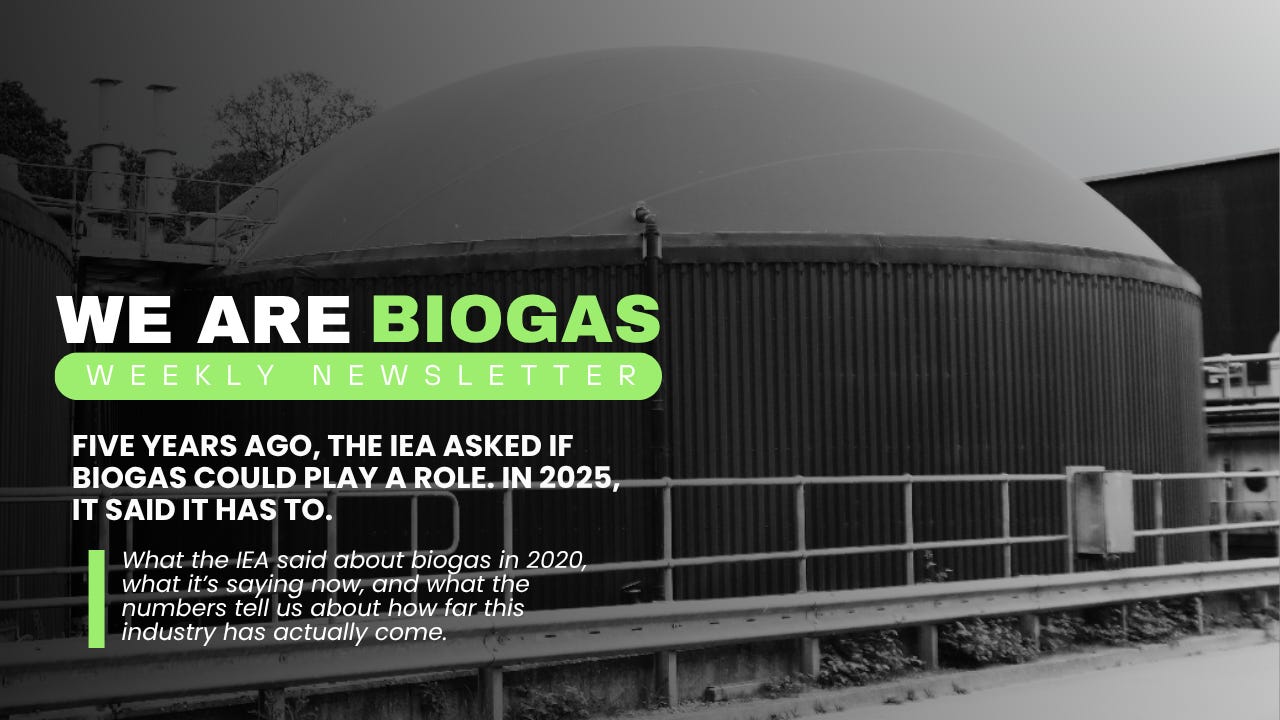
In 2020, the International Energy Agency published its first dedicated report on biogas and biomethane. It was called Prospects for Organic Growth. The title itself tells you something about where the conversation was at the time: cautious, curious, exploratory. The report asked whether biogas could play a meaningful role in the global energy transition. It mapped feedstocks, modeled scenarios, and made the case that organic waste could become a modern energy resource. It was a thorough piece of analysis. It was also, essentially, a question.
Five years later, the IEA came back with its answer.
The 2025 Outlook for Biogas and Biomethane opened with a declaration that would have sounded ambitious in 2020: “Biogases play an important and growing role in energy systems.” Not a promising option. Not a sector worth watching. A solution, specific, present tense, and overdue for attention. By the time the 2025 report dropped, the IEA had conducted a first-of-its-kind geospatial analysis across over five million locations worldwide and arrived at a number that reframes what this industry is actually sitting on.
Nearly one trillion cubic meters of biogas equivalent, producible sustainably every year, from today’s organic waste streams alone. That’s equivalent to one quarter of global natural gas demand.
The question has been answered. The industry now has to decide what to do with that answer.
What 2020 Looked Like
It’s worth going back to what the 2020 report actually found, because the contrast with 2025 is where the story of this industry’s last five years lives.
In 2020, the IEA estimated that biogas and biomethane investments had averaged less than $4 billion per year over the prior decade. To put that in context, the report noted that this was the same amount the natural gas industry typically spends every week. Biomethane plants worldwide were expected to exceed 1,000 in the course of 2020, a milestone the report noted with optimism, though that number looks modest now. The sector’s combined market share in total modern bioenergy demand stood at 5%, with projections reaching 12% by 2040 under the Stated Policies Scenario.
The framework was one of potential and uncertainty. Biogas was a technology that worked, a feedstock base that existed, and a policy environment that hadn’t yet decided what to do with either.
The word the 2020 report returned to, over and over, was “untapped.”
What 2025 Looks Like
The word in 2025 is “strategic.”
Where the 2020 report mapped what was possible, the 2025 report makes the case for what’s necessary. The shift in register is significant. As the World Biogas Association put it so eloquently, biogas and biomethane are now described as…
“…emerging as strategic fuels for decarbonising sectors that electricity alone cannot easily reach, such as heavy industry, long-haul transport, and heating.”
The flexibility, storability, and dispatchability of biogas, the qualities that made it interesting in 2020, are now framed as indispensable, not optional.
The numbers have moved, too. Global production of biogas and biomethane reached approximately 50 billion cubic meters in 2023, representing growth from the 2020 baseline and a sector meaningfully larger than when the IEA first went looking at it. Since 2020, more than 50 new policy frameworks have been introduced worldwide. The 2025 IEA forecast projects a 22% increase in combined production between 2025 and 2030, and when you filter that down to medium and large-scale projects specifically, projected growth jumps to around 80%.
But the headline from 2025 isn’t the growth forecast. It’s the utilization figure. Of the nearly one trillion cubic meters of sustainable biogas potential that exists globally, the world is currently accessing just 5%. The EU, the most developed biogas market on earth, is harnessing around 40% of its potential from waste feedstocks alone.
The gap between what we know is available and what we’re actually using is the defining fact of this industry right now.
Where the Numbers Are Coming From
Europe remains the dominant producing region, accounting for close to half of all global output. Total European production reached 22 billion cubic meters in 2024, a volume equivalent to the entire inland gas demand of Belgium, Denmark, and Ireland combined, per the EBA’s 15th Statistical Report.
The European market has reshuffled significantly since 2020. France has overtaken Germany as the continent’s largest biomethane producer, posting a 21% higher production share and a threefold advantage in number of plants, according to the EBA’s 2025 Biomethane Investment Outlook. Germany has remained relatively stable since 2017, held back by regulatory uncertainty and an aging plant fleet. Italy, Denmark, and the Netherlands remain major contributors, though year-on-year growth in those markets has been comparatively slower. Ireland, Spain, and Poland are scaling from low baselines, with Poland injecting its first biomethane into the grid in 2025.
The shift from raw biogas to biomethane is the defining trend across all of it. EU biomethane grew 14% year-on-year in 2024 against just 1% for biogas, per IEA Renewables 2025. Europe closed 2024 with 1,620 biomethane-producing facilities, and installed capacity hit 7 bcm per year by early 2025. Further, the €671 million corporate financing closed by Verdalia Bioenergy in October 2025, backed by Goldman Sachs and a consortium of seven international banks, to develop 3 TWh of biomethane capacity across Spain and Italy, was described by the company as the first and largest of its kind in the European biomethane sector. That kind of transaction doesn’t happen in a market that institutional capital hasn’t figured out.
In the US, the growth story has been consistent and significant. The American Biogas Council's most recent data shows 70 new biogas projects came online in 2025, representing more than $2 billion in new investment and pushing the total number of US facilities to nearly 2,600. Industry-wide capture capacity increased 7.5% to reach 780.7 billion cubic feet per year. RNG production rose 24% in 2025 alone, with 659 facilities now producing renewable natural gas, up from just 217 in 2020, a threefold increase in five years. For context on production volume, the IEA's Renewables 2025 report puts US biomethane output at around 136 petajoules, with the market described as one of the most dynamic globally, accelerating since 2022 on the back of California's Low Carbon Fuel Standard and the federal Renewable Fuel Standard.
Europe and the US are the established story. The more interesting question is what’s happening everywhere else.
In 2025, India made biogas blending legally mandatory for the first time. Gas suppliers must now blend biogas into their supply, starting at 1% and rising to 5% by 2028-29. Mandatory demand is a different beast from voluntary ambition, and sales in 2024-25 already surpassed everything India had sold in the five previous years combined. In a country with a potential of up to 86 billion cubic meters a year, against the current output of 3.2 billion. China is mid-pivot. Decades of small household units giving way to industrial-scale plants, state energy companies commissioning projects, and in 2024, the country’s first commercial biomethane contracts signed, all against a potential of 150 to 200 billion cubic meters a year versus the current capacity of just 300 million. And Brazil passed a law in October 2024 requiring gas companies to use biogas for the first time, 1% rising to a potential ceiling of 10%, with Petrobras launching an 11-year procurement programme in response, in a market where 930 plants are currently producing less than 2% of what the country’s agricultural waste alone could supply. Three very different countries that have looked at their organic waste, their energy bills, and their climate targets, and arrived at the same conclusion.
The Number That Stays With You
The 2025 IEA report contains one figure that this industry should be putting in every conversation it has with policymakers, investors, and anyone else who hasn’t yet worked out why biogas matters.
Harnessing global potential from manure alone, one feedstock category, universally available, already being generated whether we capture it or not, would avoid 1,000 million tonnes of CO2 from agriculture and a further 400 million tonnes from fossil fuel substitution. Manure. The thing that currently rots in fields and flows into waterways. The thing that generates methane, regardless of whether anyone captures it.
The IEA also found that five times the current level of global biomethane production could be developed at a cost equal to or lower than prevailing wholesale natural gas prices. The economics aren’t the barrier. The architecture around the economics is.
That architecture is what the five years between 2020 and 2025 have been building, imperfectly, unevenly, and not fast enough to meet the EU’s 35 billion cubic meter target for 2030, which current national plans fall approximately 25% short of. But building nonetheless.
Harnessing global potential from manure alone, one feedstock category, universally available, already being generated whether we capture it or not, would avoid 1,000 million tonnes of CO2 from agriculture and a further 400 million tonnes from fossil fuel substitution. Manure. The thing that currently rots in fields and flows into waterways. The thing that generates methane, regardless of whether anyone captures it.
The IEA also found that five times the current level of global biomethane production could be developed at a cost equal to or lower than prevailing wholesale natural gas prices. Meaning, the economics aren’t the barrier. The architecture around the economics is.
That architecture is what the five years between 2020 and 2025 have been building, imperfectly, unevenly, and not fast enough to meet the EU’s 35 billion cubic meter target for 2030, which current national plans fall approximately 25% short of. But building nonetheless.
What the Shift Actually Means
The IEA doesn’t change its language without reason. When the framing moves from “prospects” to “strategic necessity,” when biogas earns its first-ever dedicated chapter in the flagship Renewables report, when Dr. Fatih Birol stands at the launch of Renewables 2025 and says that “the pace of growth of renewables will be determined by governments,” that’s not editorial generosity. That’s recognition that the argument has been made, the data supports it, and what comes next is a question of political and financial will.
For those of us inside this industry, the shift is validation of work that has been going on for decades. For those encountering biogas for the first time, it’s an invitation to look more carefully at something that has been hiding in plain sight. In the manure, the food waste, the sewage sludge, and the agricultural residues that modern economies generate at scale, every single day.
The 2020 report asked whether biogas could play a role. The 2025 report says it has to. The distance between those two statements is where this industry has spent the last five years, and it’s a distance worth measuring.

We Are Biogas is an independent media platform covering the global biogas, biomethane, RNG, and anaerobic digestion industry. Subscribe to the weekly newsletter and follow the podcast for in-depth coverage, industry interviews, and sector analysis.