


Walking into Gruppo AB’s Biomethane Day Ireland, I felt something I don’t always feel at industry events: genuine excitement with an edge of anticipation. Not the polished, press-release kind. The kind that comes from knowing the next era of something is close enough to touch, and that the gap between here and there is mostly a task list, not a pipe dream.
Things have happened. Things are happening. And a growing number of people in Ireland are ready to close that gap, now, and together. That’s what this room was.
The Scoreboard Is Honest. So Was the Room.
Ireland’s National Biomethane Strategy, launched in May 2024, set a target that doesn’t leave much room for slow starts: 5.7 TWh of indigenously produced biomethane annually by 2030, roughly 10% of national gas demand, underpinned by 140 to 200 new AD facilities nationwide.
Two years in, two operational biomethane facilities are injecting into the national gas grid, producing approximately 75 GWh per year. Less than 1.5% of the 2030 target. That number wasn’t hidden at Biomethane Day Ireland. It was the starting point.
This is what a sector in its delivery phase looks like when it’s being honest with itself: not minimizing the gap, not catastrophizing it, but naming it clearly so the room can get to work. Panel sessions covered the full architecture of what needs to move: regulation, permitting, health and safety standards, construction and project development, grid injection, and how Ireland’s trajectory compares to European markets that have been building this industry for a decade longer. That last comparison wasn’t made to embarrass anyone. It was made because Ireland has something those earlier markets didn’t: a roadmap of what worked, what stalled, and what killed projects at planning. That’s an advantage, if you use it.
The RHO: The Right Tool, Waiting to Be Sharpened
A significant portion of the day turned on the Renewable Heat Obligation, the demand-side mechanism that would obligate fossil fuel heat suppliers to blend increasing proportions of renewable gas into their supply, starting at 1.5% and scaling toward 10% by 2030. In principle, it’s the policy instrument that converts a national strategy into a functioning market. In practice, it’s still being worked out.
The RHO Bill cleared priority drafting and EU TRIS notification, but in March 2026, the European Commission issued a Detailed Opinion finding that the bill’s proposed multiplier for indigenously produced biomethane, the mechanism explicitly designed to make domestic production commercially competitive against cheaper imports, is incompatible with EU single market rules under Article 34 TFEU. The standstill period ran to the end of June. A redesign is now mandatory.
There was no diplomatic softening of this at Biomethane Day Ireland, and there shouldn’t have been. Ireland engineered a support mechanism to protect a nascent domestic industry, a rational and defensible position, and ran directly into single market principles that don’t accommodate national carve-outs, even well-intentioned ones.
Which is why what Minister Darragh O’Brien said in his keynote address mattered. Speaking to a sold-out conference, he confirmed his intention to publish the RHO in July, alongside the planned rollout of a €200m support scheme later this year. He was also unambiguous on the strategic positioning of the sector: biomethane, in his words, is “not a nice to have, but an imperative.” That’s a meaningful statement from a minister with the legislation on his desk, and it reflects a recognition that indigenous renewable gas isn’t peripheral to Ireland’s energy security, emissions reduction, and rural development agenda. It’s load-bearing.
The legislative intent is intact. The Sectoral Capital Plan 2026–2030 has committed €100m–€200m for biomethane from the Infrastructure, Climate and Nature Fund. The capital grant programme is moving into a second round. The tools are here. Clarity of intent now needs to be matched by pace of delivery, and on that front, July is the first real test.
“The Time for Delivery Is Now.”
Richard Kennedy said it plainly: “The time for delivery is now.”
In a room full of people who have been carrying this industry forward through years of strategy documents and consultation periods and delayed legislation, that sentence landed differently than it might have somewhere else. It wasn’t a rallying cry. It was an acknowledgment of where the sector is, of how long it’s taken to get here, and of what everyone in the room already knew.
Tom O’Brien, Group CEO of Nephin Energy, framed it in similar terms: the case for biomethane in Ireland has never been clearer. The feedstock base is agricultural and abundant. Gas Networks Ireland has the grid infrastructure. The financing community is at the table. The comparison to mature European biomethane markets: Germany, Denmark, the Netherlands, isn’t a source of embarrassment; it’s a source of intelligence. Ireland can learn from what those markets have built and compress the development timeline as a result.
What it still needs is the legislative layer fully in place and functional. The RHO redesigned and enacted. The planning and permitting framework streamlined. The consenting environment consistent enough that a project can model its timeline with confidence. These aren’t abstract policy asks, they’re the specific blockers between where Ireland is today and where it has committed to be by 2030.
This Event Is Doing Something Real
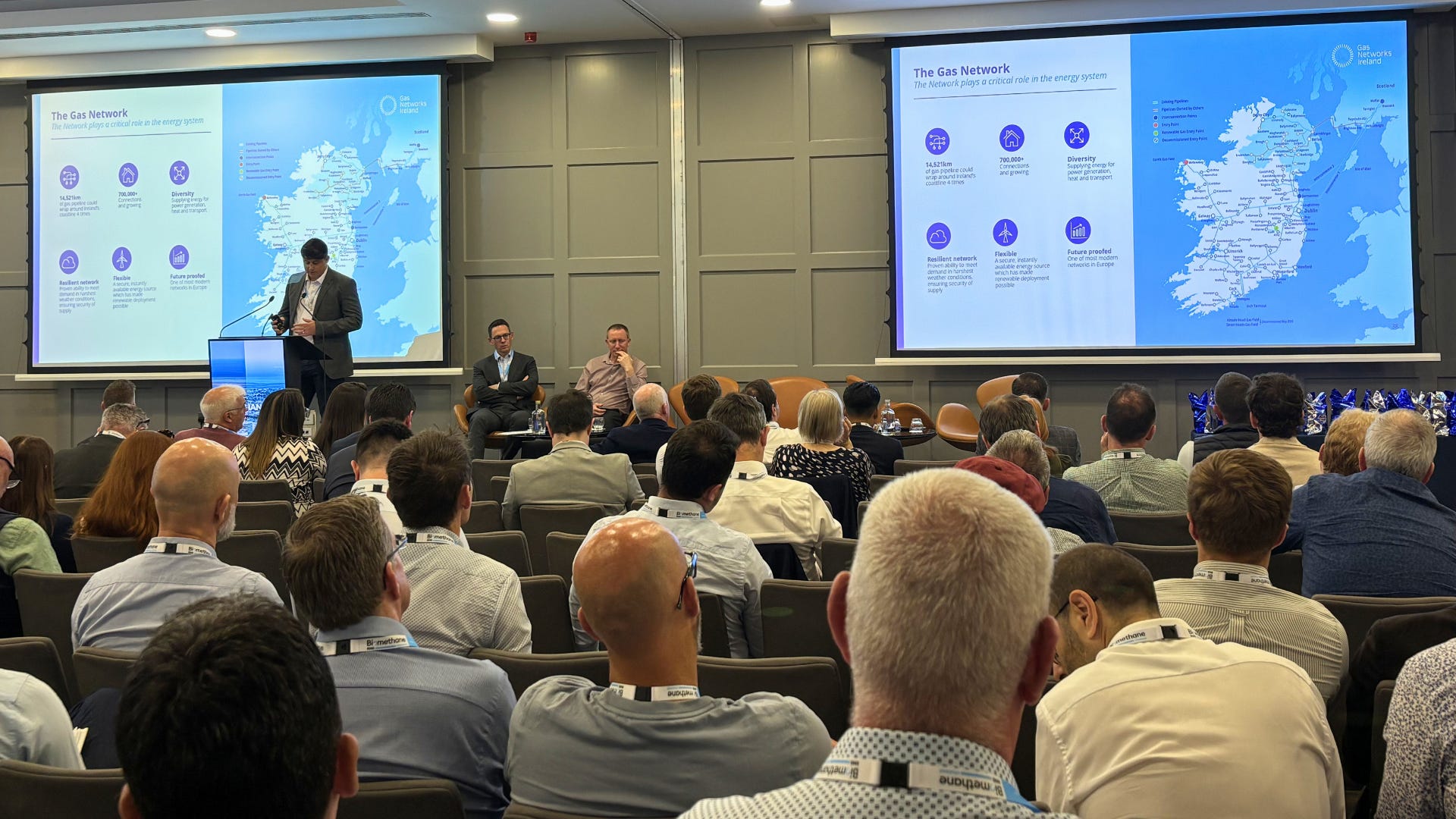
Biomethane Day Ireland is a young conference, but it’s filling a gap that matters. The Irish biomethane sector is at exactly the stage where the industry needs to be in the same room: developers, farmers, grid operators, financiers, and policymakers working through the same problems with access to the same information at the same time. That alignment is not a given. Events that create it are worth paying attention to.
I’m already thinking about what Biomethane Day 2027 looks like. If this edition was about setting the intention, delivery, and the collective will to get there, then next year’s event should be about measuring the distance traveled. How many projects moved from feasibility to finance? How many plants broke ground? How did the RHO redesign land? Did the capital grant programme move fast enough to matter?
Now comes the part where the industry finds out what it’s actually made of.

Biomethane Day Ireland 2026 was organized by Gruppo AB / Biomethane RNG Channel and sponsored by Nephin Energy. We Are Biogas attended as independent media.